Lorenz Curve – Measuring Income Inequality
Macroeconomics
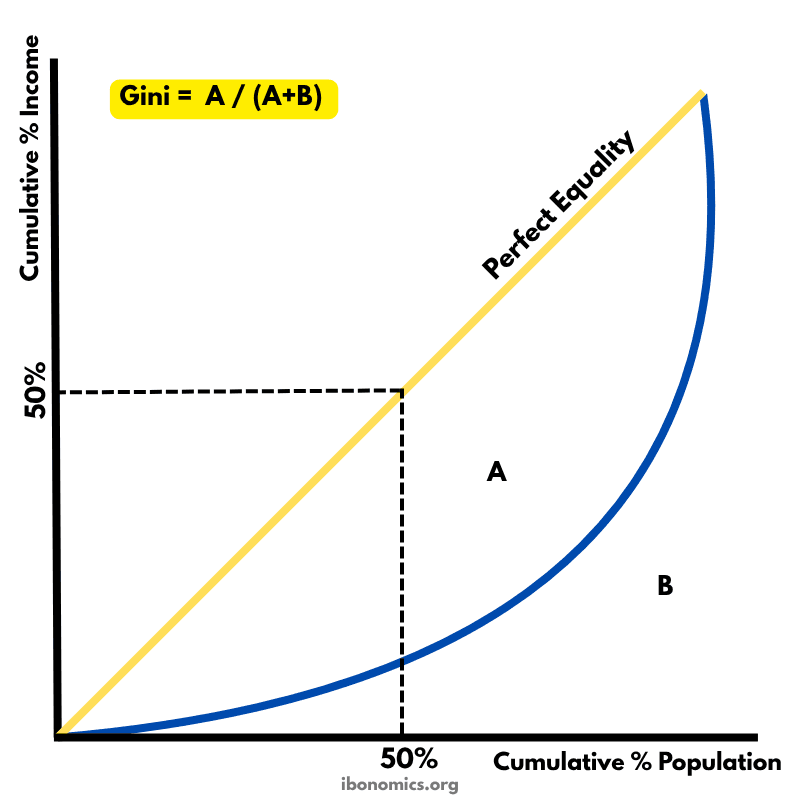
This diagram shows the Lorenz Curve used to measure income inequality in an economy. It compares the actual distribution of income with a perfectly equal distribution.
Curves and Elements
perfect equality
The 45-degree yellow line represents perfect income equality.
lorenz curve
The blue Lorenz Curve represents the actual distribution of income.
area a
Area A is between the Lorenz Curve and the line of equality, used in calculating the Gini coefficient.
area b
Area B lies below the Lorenz Curve, also used in the Gini coefficient formula.
gini formula
Gini = A / (A + B), measuring income inequality from 0 (equality) to 1 (inequality).
The 45-degree yellow line represents perfect income equality, where each percentage of the population earns an equal share of total income.
The blue curved line is the Lorenz Curve, showing the actual cumulative distribution of income across the population.
Area A is the space between the line of perfect equality and the Lorenz Curve, while area B lies under the Lorenz Curve.
The Gini coefficient is calculated as A / (A + B) and ranges from 0 (perfect equality) to 1 (maximum inequality).
A more bowed-out Lorenz Curve indicates greater inequality, while a curve closer to the line of equality indicates a more equal income distribution.
More Macroeconomics Diagrams
Explore other diagrams from the same unit to deepen your understanding

A diagram illustrating the fluctuations in real GDP over time, including periods of boom, recession, peak, and trough, relative to the long-term trend of economic growth.

This diagram shows the intersection of the aggregate demand (AD) and short-run aggregate supply (AS) curves to determine the equilibrium price level and real GDP.

A diagram showing the Classical model of aggregate demand (AD), short-run aggregate supply (SRAS), and long-run aggregate supply (LRAS), used to explain long-run macroeconomic equilibrium.

A Keynesian aggregate demand and long-run aggregate supply (AD–LRAS) diagram showing how real GDP and the price level interact across different phases of the economy, including spare capacity and full employment.

A diagram showing an output (deflationary) gap, where the economy is producing below its full employment level of output (Ye).
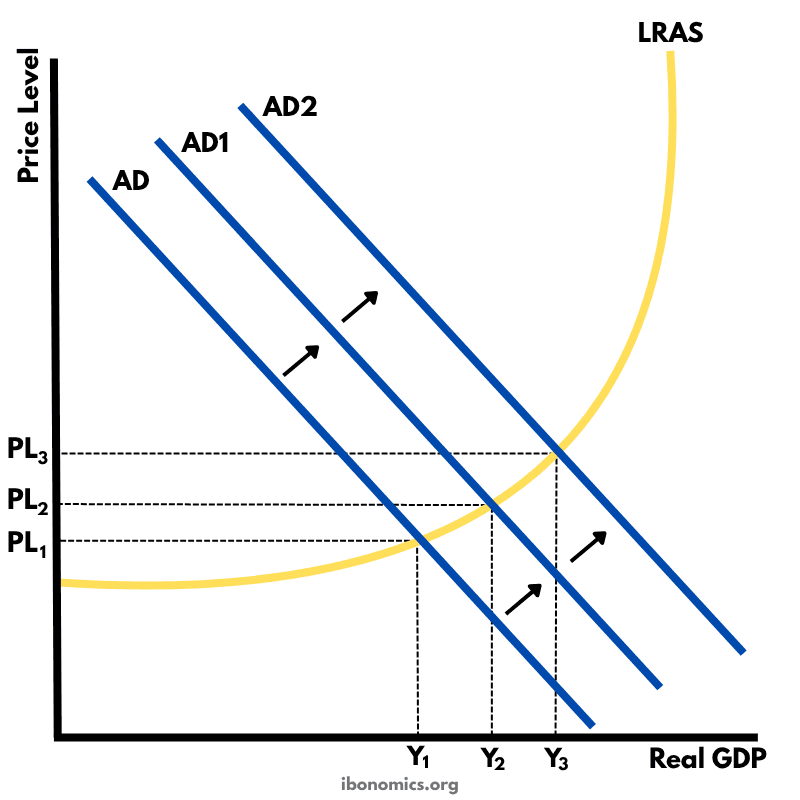
This diagram shows how an initial increase in aggregate demand leads to a multiplied increase in national output (real GDP) and price level within the Keynesian framework.