Inflation vs Disinflation – Rising Prices vs Slower Price Increases
Macroeconomics
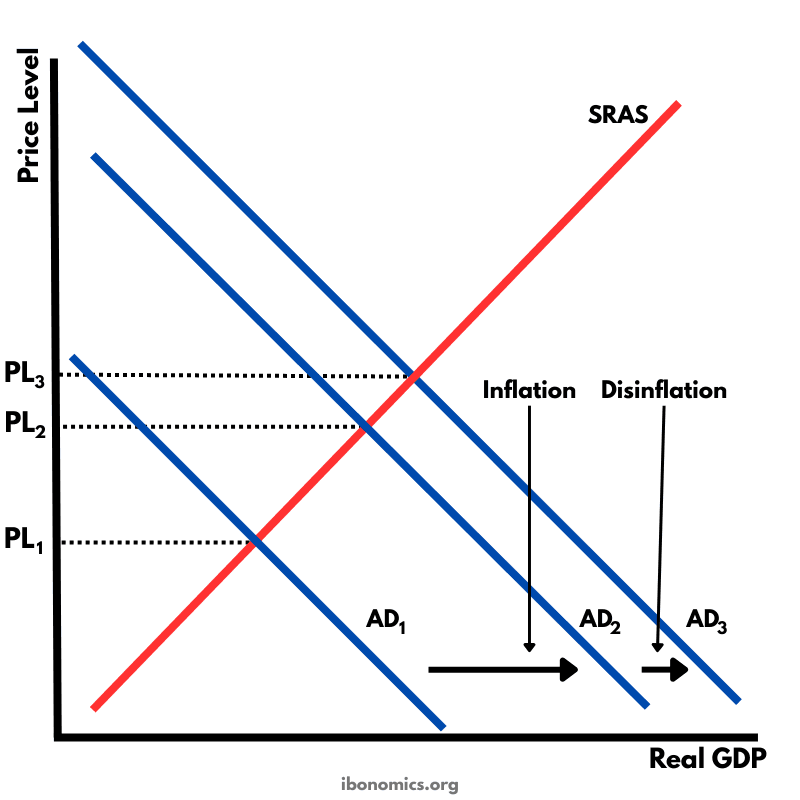
This diagram uses the AD and SRAS model to show the difference between inflation and disinflation. Inflation is shown when aggregate demand increases from AD1 to AD2, causing the equilibrium price level to rise from PL1 to PL2. Disinflation is shown when aggregate demand continues to increase from AD2 to AD3, but by a smaller amount than before, so the price level still rises from PL2 to PL3 but at a slower rate. Therefore, during disinflation the price level is still increasing, but the rate of inflation is falling.
Curves and Elements
ad1
AD1: Initial aggregate demand curve where equilibrium is at PL1.
ad2
AD2: Aggregate demand after a larger increase in demand, creating inflation as the price level rises to PL2.
ad3
AD3: Aggregate demand after a smaller further increase in demand, creating disinflation as the price level rises to PL3 but more slowly.
sras
SRAS: Short-run aggregate supply curve. With SRAS unchanged, shifts in AD change both the price level and real GDP.
Starting at AD1, the economy is initially in equilibrium at price level PL1 where AD1 intersects SRAS.
When aggregate demand increases to AD2, equilibrium moves up SRAS and the price level rises from PL1 to PL2. This is inflation because the general price level is rising.
Aggregate demand increases again from AD2 to AD3, but the shift is smaller than the previous increase in AD.
Because the second AD increase is smaller, the price level still rises from PL2 to PL3, but by a smaller amount than before. This is disinflation.
Disinflation does not mean prices are falling. It means prices are rising more slowly, so the inflation rate is decreasing.
More Macroeconomics Diagrams
Explore other diagrams from the same unit to deepen your understanding

A diagram illustrating the fluctuations in real GDP over time, including periods of boom, recession, peak, and trough, relative to the long-term trend of economic growth.

This diagram shows the intersection of the aggregate demand (AD) and short-run aggregate supply (AS) curves to determine the equilibrium price level and real GDP.

A diagram showing the Classical model of aggregate demand (AD), short-run aggregate supply (SRAS), and long-run aggregate supply (LRAS), used to explain long-run macroeconomic equilibrium.

A Keynesian aggregate demand and long-run aggregate supply (AD–LRAS) diagram showing how real GDP and the price level interact across different phases of the economy, including spare capacity and full employment.

A diagram showing an output (deflationary) gap, where the economy is producing below its full employment level of output (Ye).
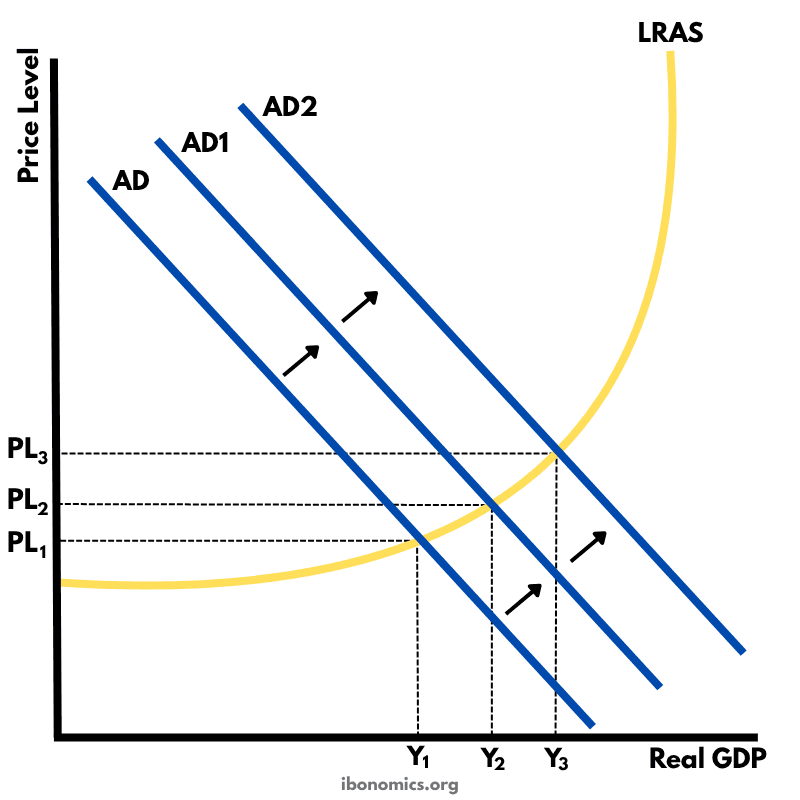
This diagram shows how an initial increase in aggregate demand leads to a multiplied increase in national output (real GDP) and price level within the Keynesian framework.