Scarcity, Choice and Opportunity Cost in IB Economics
A clear introduction to scarcity, choice, opportunity cost and the core foundations of IB Economics.
Scarcity, Choice and Opportunity Cost in IB Economics
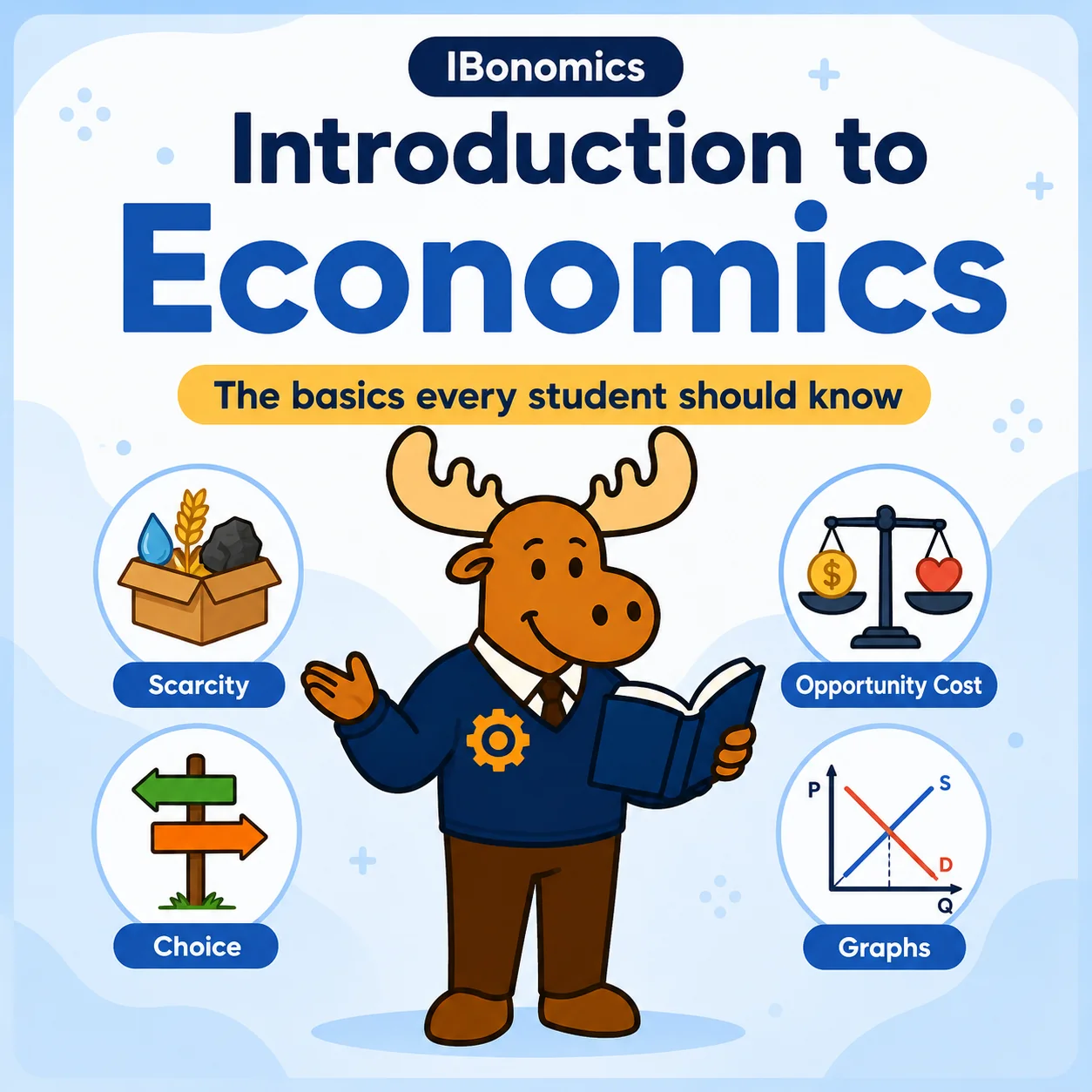
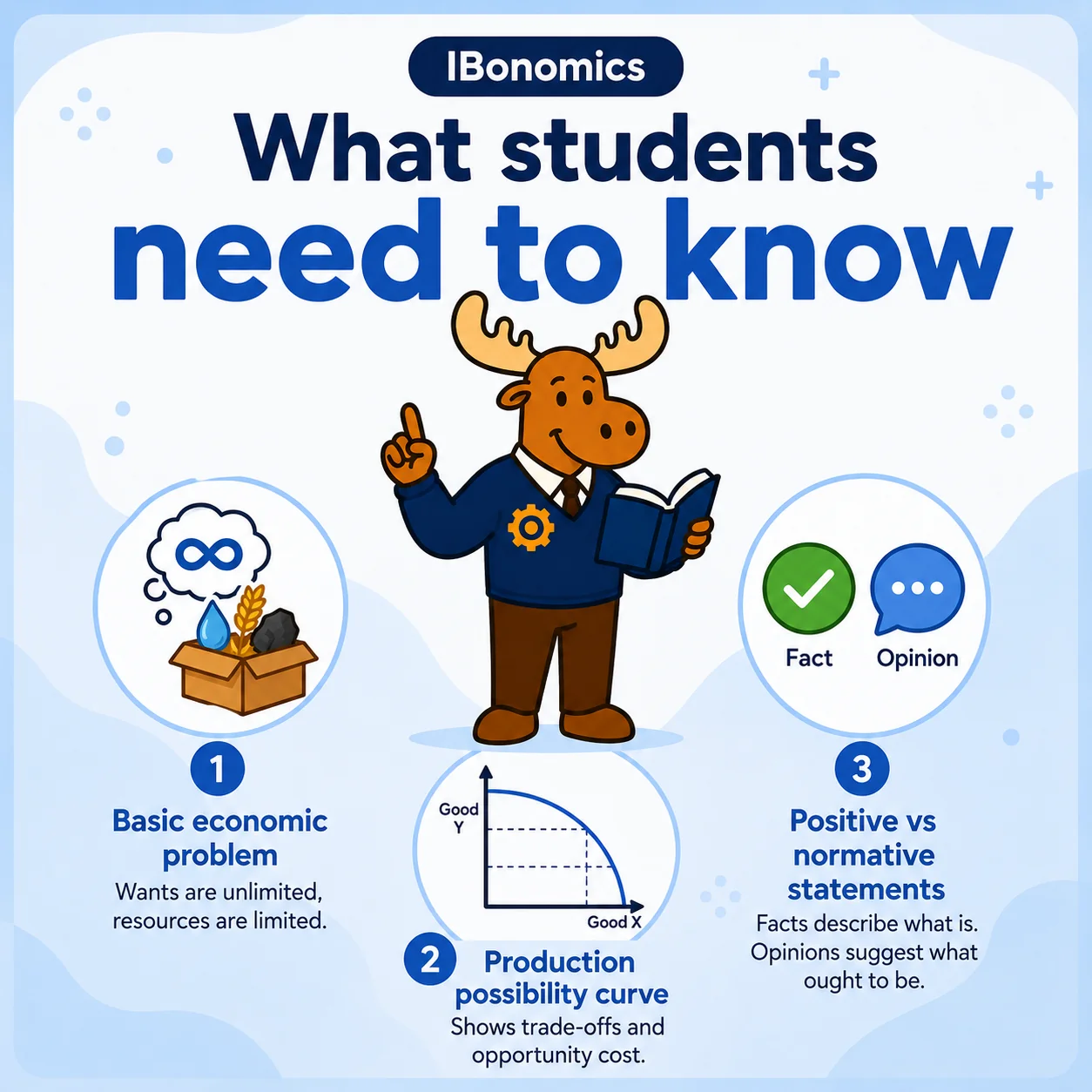
Economics begins with a simple problem: people want more than the world can provide. Individuals want more goods and services, firms want more resources and profit, and governments want to improve living standards while staying within budget and resource limits.
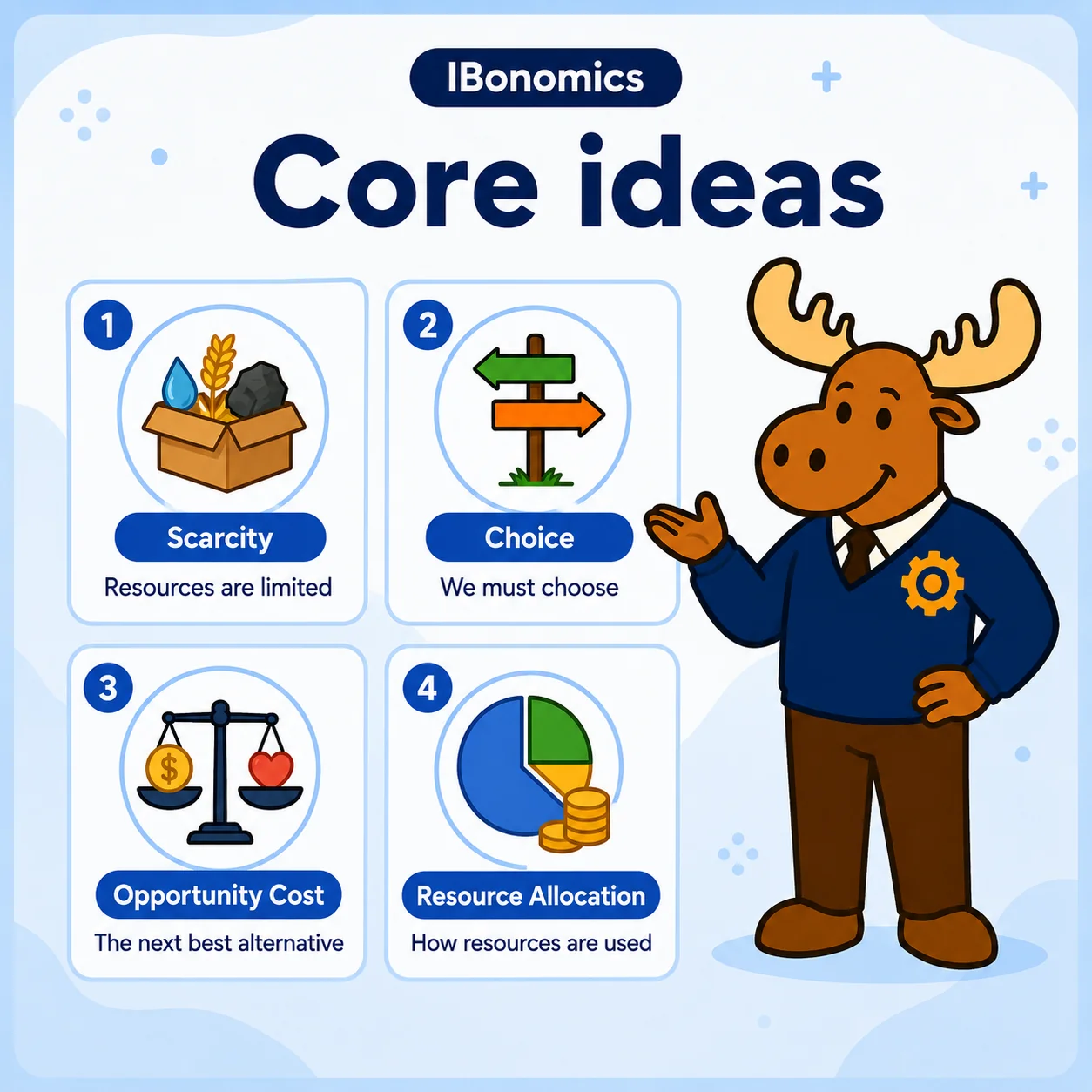
This is why scarcity is the starting point of IB Economics. Scarcity explains why choices must be made. Choice creates opportunity cost. Opportunity cost then helps economists analyse decision-making by consumers, producers and governments.
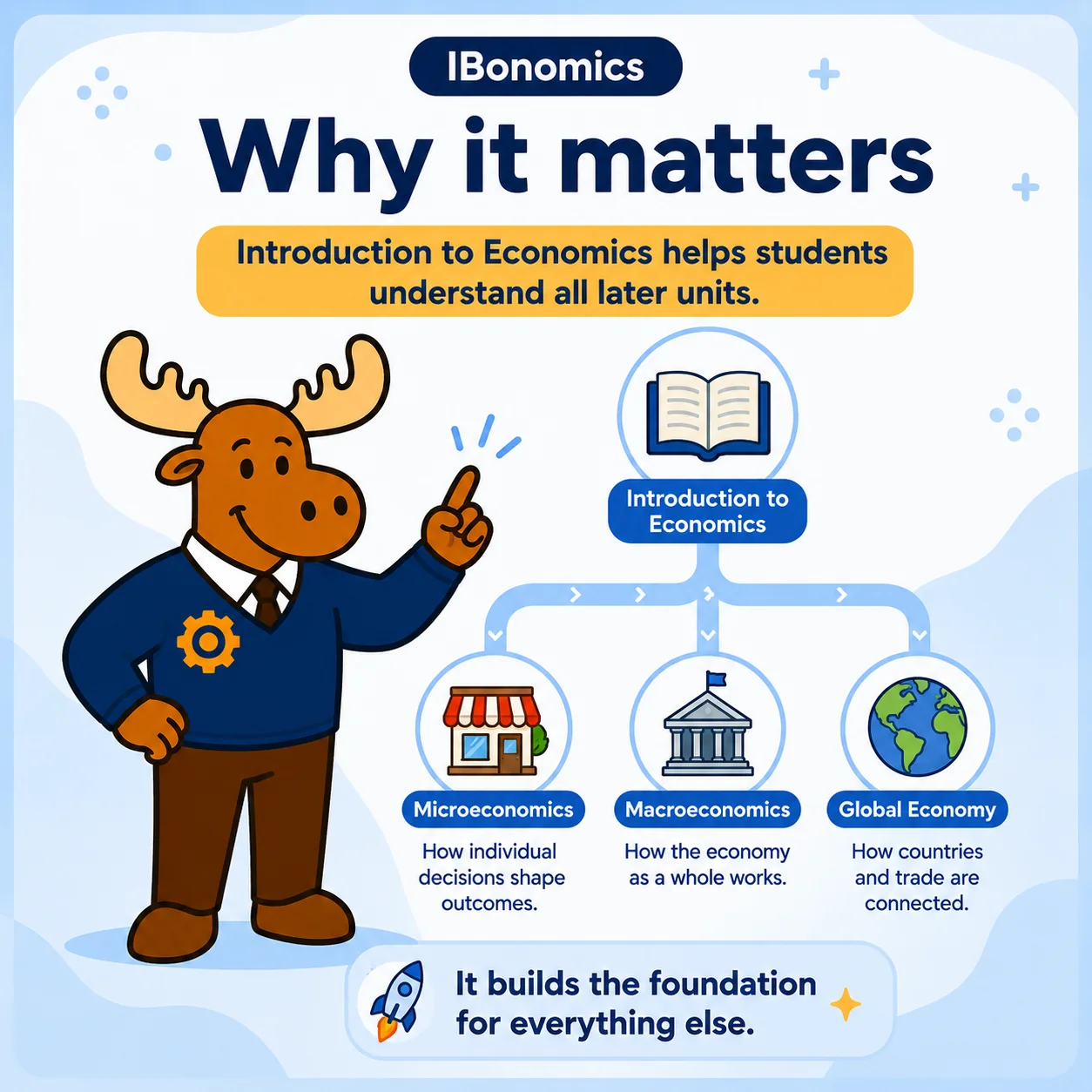
In IB Economics, these ideas are not just definitions to memorise. They form the foundation for almost every later topic, including markets, government intervention, sustainability, economic growth, inequality and international trade.
Why economics starts with scarcity
Scarcity means that resources are limited relative to unlimited wants. This does not only mean poverty or shortage. A resource can be scarce even in a rich country if people want more of it than is freely available.
For example, time is scarce because students cannot revise every subject, sleep eight hours, work a part-time job and socialise endlessly at the same time. Land is scarce because the same area cannot be used simultaneously for housing, farming, factories and nature reserves. Government budgets are scarce because spending more on healthcare may mean less money for defence, education or tax cuts.
IB Economics treats scarcity as the basic economic problem. Because resources are scarce, societies need to decide how they are used. This connects directly to scarcity and sustainability, where the focus expands from short-term allocation to long-term resource use.
Choice and opportunity cost
Choice exists because scarce resources have alternative uses. When you choose one option, you give up another. The value of the next best alternative forgone is called opportunity cost.
Opportunity cost is not every possible thing you give up. It is the next best alternative.
If a student spends two hours revising economics instead of biology, the opportunity cost is the benefit they would have gained from studying biology, assuming biology was the next best alternative. If a government spends money building a new railway instead of a hospital, the opportunity cost is the hospital services that could have been provided.
This idea matters because economics is not only about money. Decisions often involve time, resources, welfare, environmental quality and future possibilities. That is why opportunity cost and free goods is one of the most important early syllabus areas.
Free goods and economic goods
A free good has no opportunity cost because it is not scarce. In theory, air in normal circumstances is often used as an example because consuming it does not usually prevent others from also consuming it.
An economic good is scarce and therefore has an opportunity cost. Most goods and services in IB Economics are economic goods: food, housing, transport, education, healthcare, energy and labour.
The distinction is useful because it reminds students that price is not the only sign of scarcity. Some resources may appear free to users but still have opportunity costs for society. Clean air, public beaches and stable climate conditions may not always have market prices, but they can still be scarce in an economic sense if human activity damages or overuses them.
This becomes especially important later in market failure, where markets may ignore environmental costs unless governments intervene.
Factors of production
To understand scarcity properly, IB Economics uses the concept of factors of production. These are the resources used to produce goods and services.
The four main factors are land, labour, capital and entrepreneurship.
Land refers to natural resources, such as oil, water, forests, minerals and physical space. Labour refers to human effort, both physical and mental. Capital refers to man-made resources used in production, such as machinery, tools, roads and factories. Entrepreneurship refers to the ability to organise the other factors of production, take risks and create new goods or services.
These resources are limited, so economies must decide how to allocate them. This is why factors of production are closely linked to scarcity and opportunity cost.
For example, if labour and capital are used to produce electric cars, they cannot be used at the same time to produce buses, medical equipment or housing. The economy must make a choice.
The three basic economic questions
Because resources are scarce, every economy must answer three basic economic questions:
- What should be produced?
- How should it be produced?
- For whom should it be produced?
These questions apply to all economic systems, whether an economy is mainly market-based, planned or mixed.
In a market economy, prices and profit incentives play a large role in answering these questions. Firms produce goods that consumers are willing and able to buy. In a planned economy, the government plays a much larger role in deciding what is produced and how resources are allocated. In a mixed economy, both markets and governments influence the outcome.
For IB students, the key point is that all economic systems face the same basic problem. The difference is how they respond to scarcity.
You can explore this further in the basic economic questions.
The Production Possibilities Curve
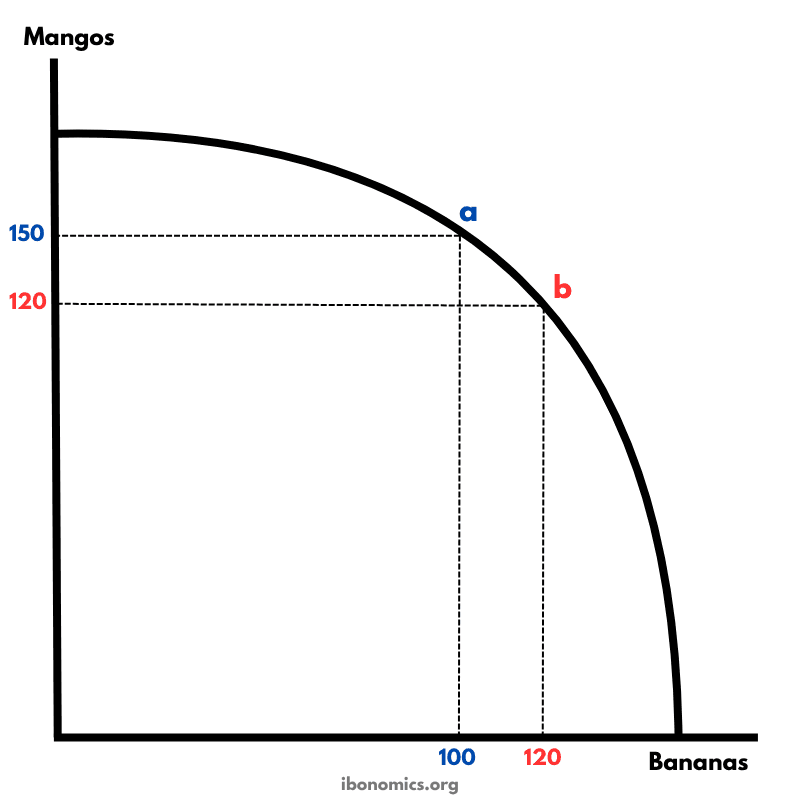
The Production Possibilities Curve, or PPC, is one of the first major diagrams in IB Economics. It shows the maximum combinations of two goods or groups of goods that an economy can produce when all resources are fully and efficiently used.
A typical PPC has one good on the horizontal axis and another good on the vertical axis. The curve slopes downward because producing more of one good requires producing less of the other. This downward slope shows opportunity cost.
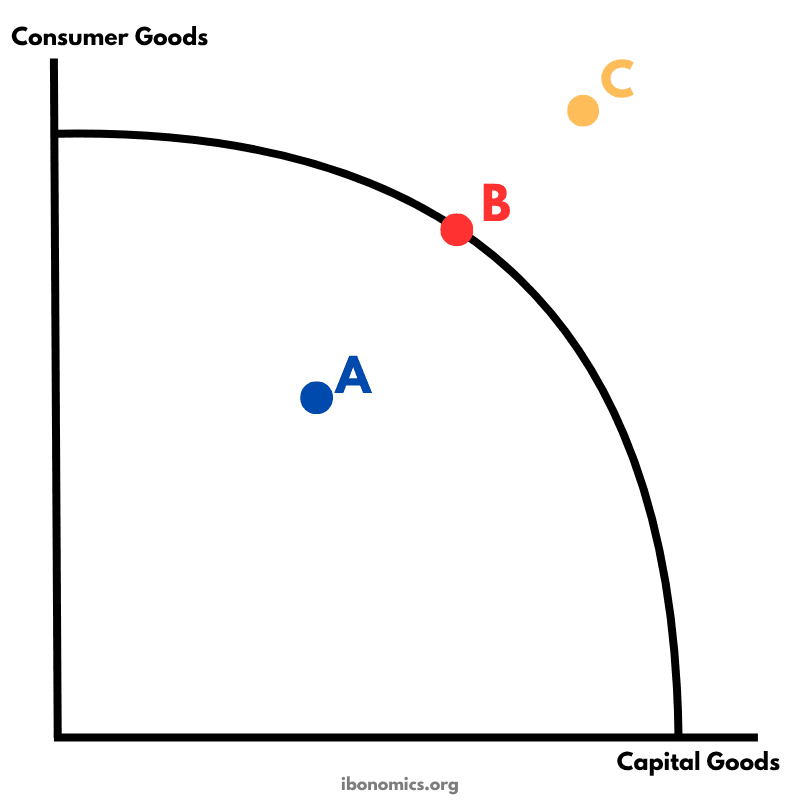
A point on the PPC is productively efficient because resources are fully used. A point inside the PPC is inefficient because the economy is not using all available resources or is using them poorly. A point outside the PPC is currently unattainable with existing resources and technology.
The PPC helps students visualise scarcity, choice and opportunity cost in one model. If an economy moves along the PPC, it reallocates resources between two outputs. If the entire PPC shifts outward, productive potential has increased, perhaps because of better technology, more resources or improved human capital.
This is an important distinction: a movement along the PPC shows a change in the combination of goods produced, while a shift of the PPC shows a change in the economy’s productive capacity.
For a deeper diagram explanation, see the Production Possibilities Curve.
Economics as a social science
Economics is a social science because it studies human behaviour, choices and institutions. Economists build models to simplify reality and identify relationships between variables.
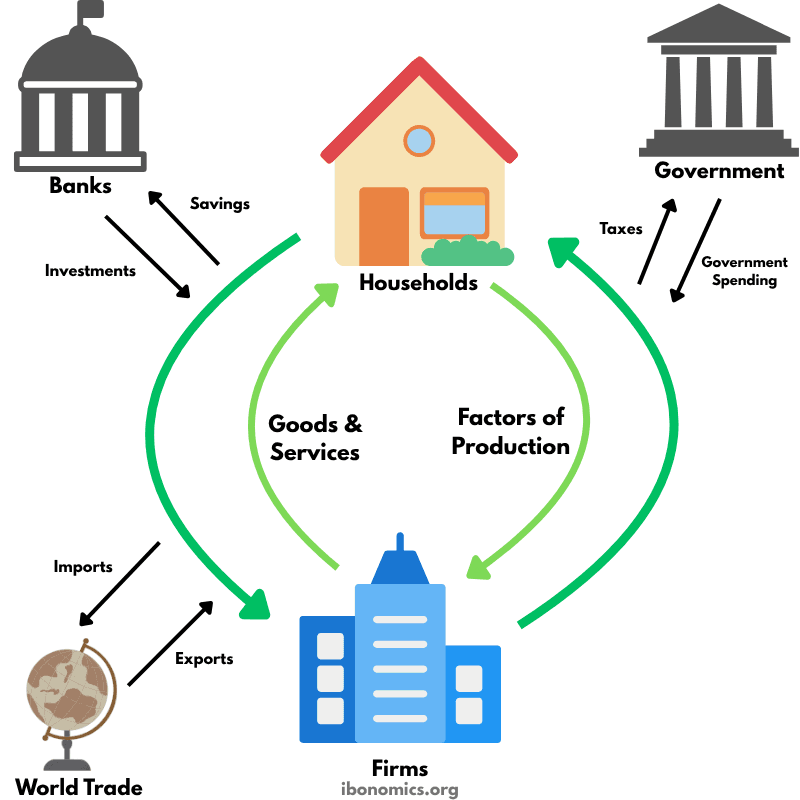
For example, a demand and supply model simplifies the behaviour of buyers and sellers. A PPC simplifies the choices an economy faces between two types of output. A circular flow model simplifies the movement of income between households and firms.
Models are useful because they make complex situations easier to analyse. However, they rely on assumptions. This means students should avoid saying that a model proves something in the real world. A model shows a relationship under certain assumptions.
This distinction matters in IB Economics because strong answers often combine diagram analysis with evaluation. You need to explain what the model suggests, then consider its limitations.
This connects directly to economics as a social science and economic methodology.
Positive and normative statements
A positive statement is based on facts or testable claims. For example, “An increase in the price of petrol is likely to reduce the quantity demanded, ceteris paribus” is a positive statement because it can be tested using evidence.
A normative statement is based on value judgements. For example, “The government should increase taxes on petrol” is normative because it depends on views about fairness, efficiency, the environment and the role of government.
IB students should be careful with this distinction. Economics often uses positive analysis to explain what is likely to happen, but policy decisions usually involve normative judgements about what should happen.
For example, a carbon tax may reduce pollution, but whether it is the best policy depends on values, priorities and trade-offs.
The nine central concepts
The IB Economics course is organised around nine central concepts: scarcity, choice, efficiency, equity, economic well-being, sustainability, change, interdependence and intervention.
Scarcity and choice are the starting points, but the other concepts help students evaluate real-world economic decisions.
Efficiency asks whether resources are used in the best possible way. Equity asks whether outcomes are fair. Sustainability asks whether present decisions damage future living standards. Interdependence highlights how consumers, firms, governments and countries affect one another. Intervention examines when governments should influence markets or the wider economy.
These concepts are especially useful in essays. They help students move beyond simple diagram explanation and build stronger evaluation.
You can review them in the nine central concepts.
IB exam relevance and common mistakes
In exams, scarcity, choice and opportunity cost often appear in definitions, short-answer questions and diagram-based explanations. They also appear indirectly in longer essays whenever you discuss trade-offs.
A common mistake is defining scarcity as “not enough money.” Money can be scarce for an individual, but the economic problem is broader. It is about limited resources relative to unlimited wants.
Another common mistake is confusing opportunity cost with total cost. Opportunity cost is not the full cost of an option. It is the value of the next best alternative forgone.
Students also sometimes say that points outside the PPC are impossible. A better answer is that they are currently unattainable with existing resources and technology. They may become attainable if productive capacity increases.
Finally, be careful when discussing free goods. A good is not free simply because the consumer does not pay directly. Public healthcare, public education and roads may be free at the point of use, but they still use scarce resources and therefore have an opportunity cost.
Evaluation: why these ideas matter in the real world
Scarcity and opportunity cost are powerful because they explain why economic decisions involve trade-offs.
A government may want lower taxes, better healthcare, stronger defence, cleaner energy and less debt. It usually cannot achieve all of these goals fully at the same time. A firm may want lower costs, higher quality, better wages and larger profits. A household may want to save more, consume more and work fewer hours. Each decision involves alternatives.
However, opportunity cost can be difficult to measure in practice. The next best alternative is not always obvious. Governments may disagree about whether spending on education, infrastructure or tax cuts creates the greatest long-term benefit. Environmental opportunity costs can also be underestimated if markets fail to reflect damage to ecosystems or future generations.
This is why IB Economics does not stop at simple models. The course asks students to explain trade-offs, use diagrams, apply real-world examples and evaluate limitations.
Conclusion
Scarcity, choice and opportunity cost are the foundations of IB Economics. Scarcity creates the need to choose. Choice creates opportunity cost. Opportunity cost helps explain why individuals, firms and governments face trade-offs.
Once you understand these ideas, later topics become much easier to connect. Demand and supply, government intervention, market failure, economic growth, sustainability and trade all build on the same basic problem: resources are limited, wants are unlimited, and every decision has a cost.
Related syllabus topics
What Is Economics? Scarcity, Choice, and Economic Models
Unit 1.1: What Is Economics? Scarcity, Choice, and Economic Models
Economics as a Social Science
Unit 1.1: What Is Economics? Scarcity, Choice, and Economic Models
Nine Central Concepts
Unit 1.1: What Is Economics? Scarcity, Choice, and Economic Models
Factors of Production
Unit 1.1: What Is Economics? Scarcity, Choice, and Economic Models
Scarcity and Sustainability
Unit 1.1: What Is Economics? Scarcity, Choice, and Economic Models
Opportunity Cost and Free Goods
Unit 1.1: What Is Economics? Scarcity, Choice, and Economic Models
Basic Economic Questions
Unit 1.1: What Is Economics? Scarcity, Choice, and Economic Models
Production Possibilities Curve (PPC)
Unit 1.1: What Is Economics? Scarcity, Choice, and Economic Models
Circular Flow of Income Model
Unit 1.1: What Is Economics? Scarcity, Choice, and Economic Models