Market Failure in IB Economics: When Markets Allocate Resources Inefficiently
A clear IB Economics explanation of market failure, including externalities, public goods, asymmetric information, market power, equity and government responses.
Market Failure in IB Economics: When Markets Allocate Resources Inefficiently
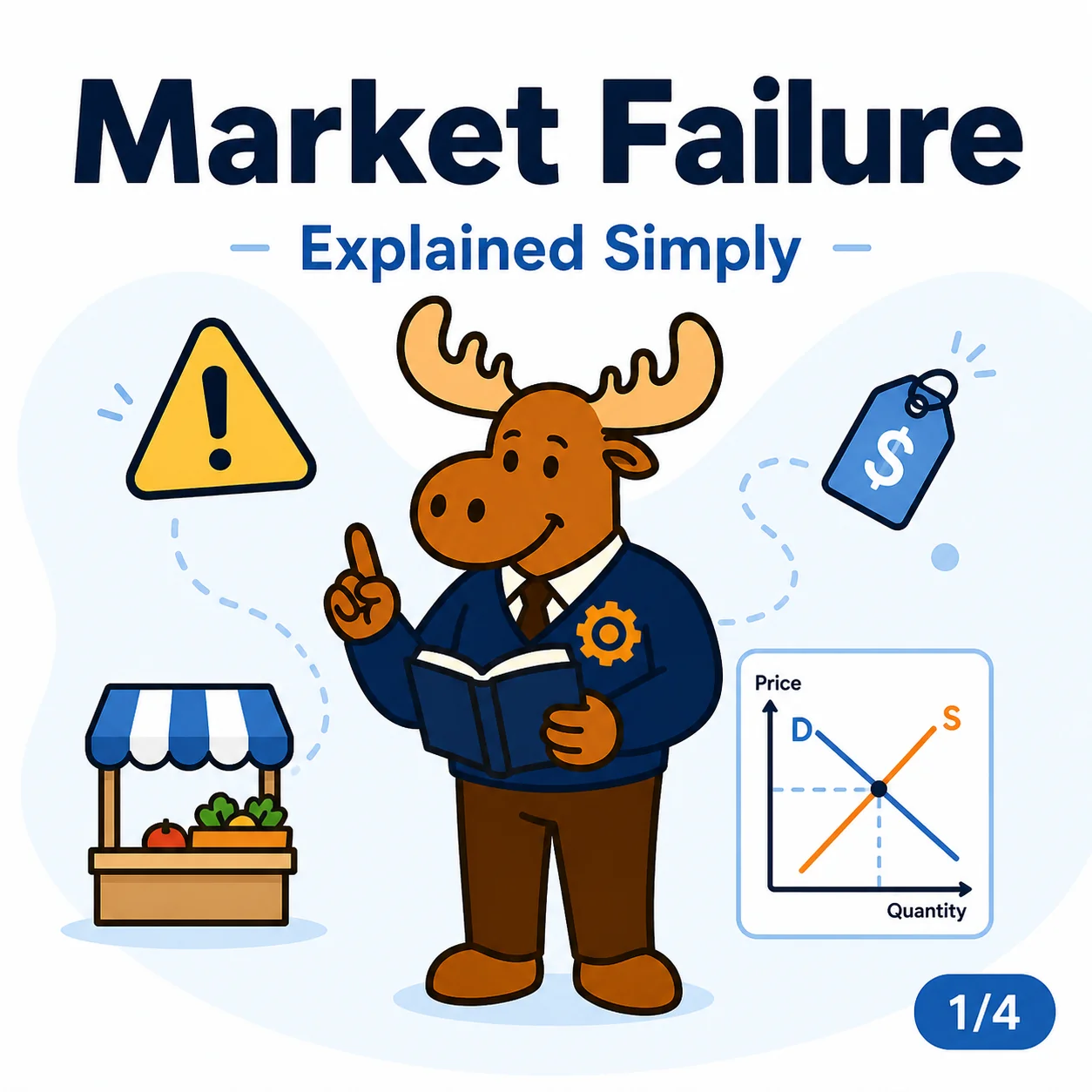
Market failure occurs when free markets fail to allocate resources efficiently. In other words, the market outcome does not maximise social welfare.
This is one of the most important topics in IB Microeconomics because it shows that markets can be powerful but imperfect. Demand and supply can coordinate consumers and producers, but the result may still be inefficient, unfair or harmful to society.
Market failure helps explain why governments may tax pollution, subsidise education, provide public goods, regulate monopolies, require product information or redistribute income. The key IB skill is not simply saying “the government should intervene.” It is explaining why the market fails, what the welfare loss is, and whether government intervention is likely to improve the outcome.
What market failure means
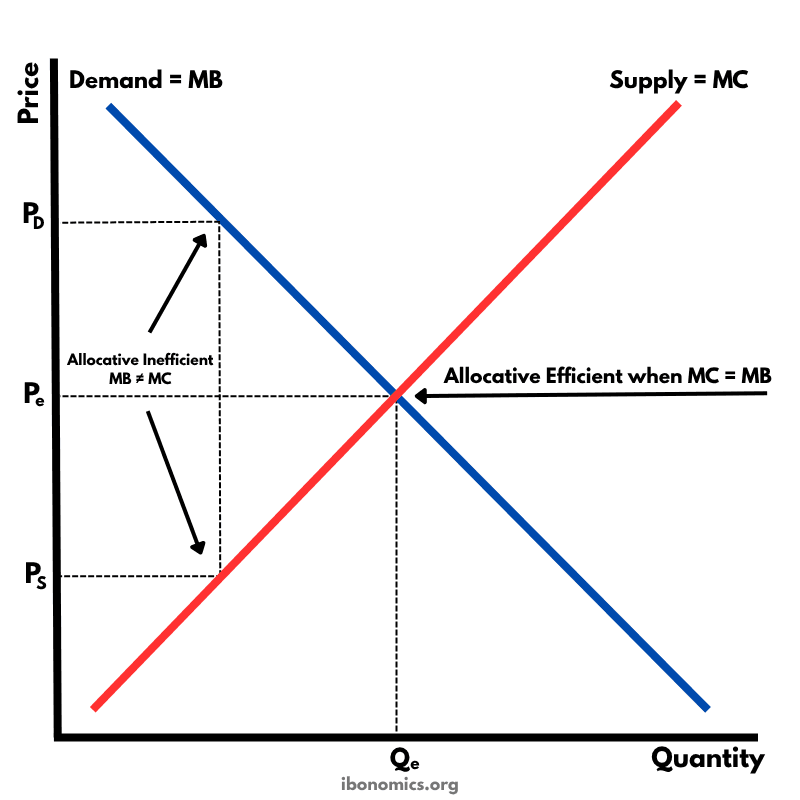
A market is allocatively efficient when resources are allocated in a way that maximises social welfare. In IB Economics, this is often shown where marginal social benefit equals marginal social cost.
Marginal social benefit, or MSB, is the extra benefit to society from consuming one more unit of a good. Marginal social cost, or MSC, is the extra cost to society from producing one more unit.
A market fails when the free market equilibrium does not occur where MSB equals MSC. This means either too much or too little of a good is produced or consumed from society’s point of view.
For example, if a factory produces goods but also pollutes a river, the private cost faced by the firm may be lower than the full social cost. The market may then produce too much of the good because the external cost is ignored.
This connects directly to allocative efficiency and social community surplus, which are essential for understanding welfare analysis.
The core intuition: private decisions can create social costs
Markets work through private incentives. Consumers compare private benefits with prices. Producers compare private costs with revenues. If all relevant costs and benefits are reflected in market prices, the market can allocate resources efficiently.
Market failure occurs when private incentives do not match social welfare.
This can happen when third parties are affected, when goods are non-excludable or non-rivalrous, when buyers or sellers lack important information, when firms have too much market power, or when the market outcome is considered unfair.
The important IB point is that market failure is not just “a bad outcome.” It has a specific economic meaning: the free market fails to achieve allocative efficiency.
Negative externalities
A negative externality occurs when the production or consumption of a good creates an external cost for a third party.
A negative production externality happens when producing a good harms others. Pollution from factories, noise from airports and carbon emissions from energy production are common examples.
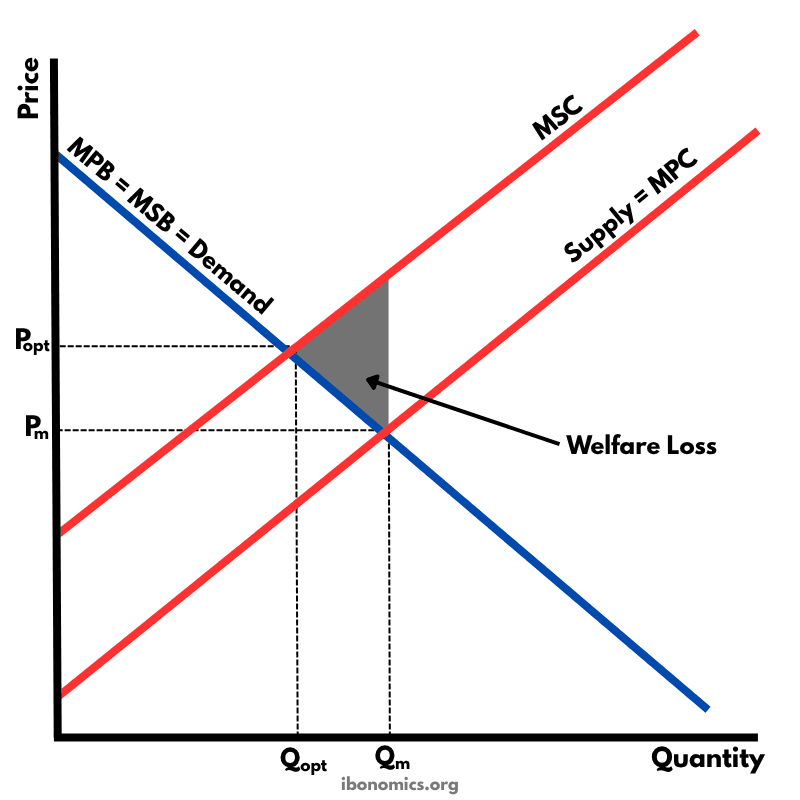
In a negative production externality diagram, the vertical axis shows costs and benefits, and the horizontal axis shows quantity. The marginal private cost curve, MPC, reflects the firm’s private production costs. The marginal social cost curve, MSC, lies above MPC because it includes external costs. The marginal social benefit curve, MSB, represents the benefit to consumers and society from consumption.
The free market equilibrium occurs where MPC equals MSB. The socially efficient level occurs where MSC equals MSB. Since MPC is below MSC, the market produces too much. The result is overproduction and welfare loss.
A negative consumption externality happens when consuming a good harms others. Cigarette smoke affecting non-smokers is a common example. In this case, marginal private benefit is higher than marginal social benefit, so the good is overconsumed.
These ideas are covered in market failure, externalities and common pool resources.
Positive externalities
A positive externality occurs when the production or consumption of a good creates an external benefit for a third party.
A positive consumption externality happens when consuming a good benefits others. Education is a common example because an educated population may increase productivity, civic participation and social outcomes beyond the private benefit received by the student.
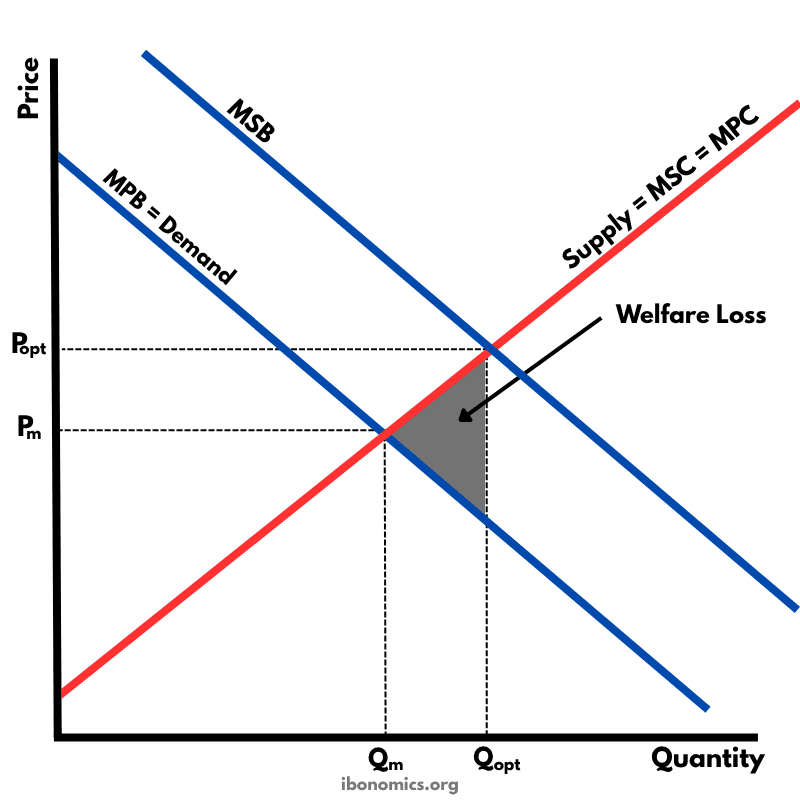
In a positive consumption externality diagram, the vertical axis shows costs and benefits, and the horizontal axis shows quantity. The marginal private benefit curve, MPB, reflects the benefit to consumers. The marginal social benefit curve, MSB, lies above MPB because it includes external benefits. The marginal social cost curve, MSC, represents production costs.
The free market equilibrium occurs where MPB equals MSC. The socially efficient level occurs where MSB equals MSC. Since MSB is above MPB, the market produces or consumes too little. The result is underconsumption and welfare loss.
A positive production externality happens when production benefits third parties, such as research and development that creates knowledge spillovers.
For IB exams, the central logic is clear: negative externalities usually cause overproduction or overconsumption, while positive externalities usually cause underproduction or underconsumption.
Public goods
A public good is non-rivalrous and non-excludable.
Non-rivalrous means one person’s consumption does not reduce the amount available for others. Non-excludable means it is difficult or impossible to prevent non-payers from consuming the good.
Street lighting, flood defence systems and national defence are common examples.
Public goods create market failure because of the free rider problem. If people can benefit without paying, private firms may not be able to charge consumers directly. As a result, public goods may be underprovided or not provided at all by the free market.
This does not mean every good provided by the government is a public good. Healthcare and education are often provided or subsidised by governments, but they are not pure public goods because they are rivalrous and excludable to some extent.
For IB students, the key is to use the two characteristics carefully. A public good must be both non-rivalrous and non-excludable.
You can review this through market failure and public goods.
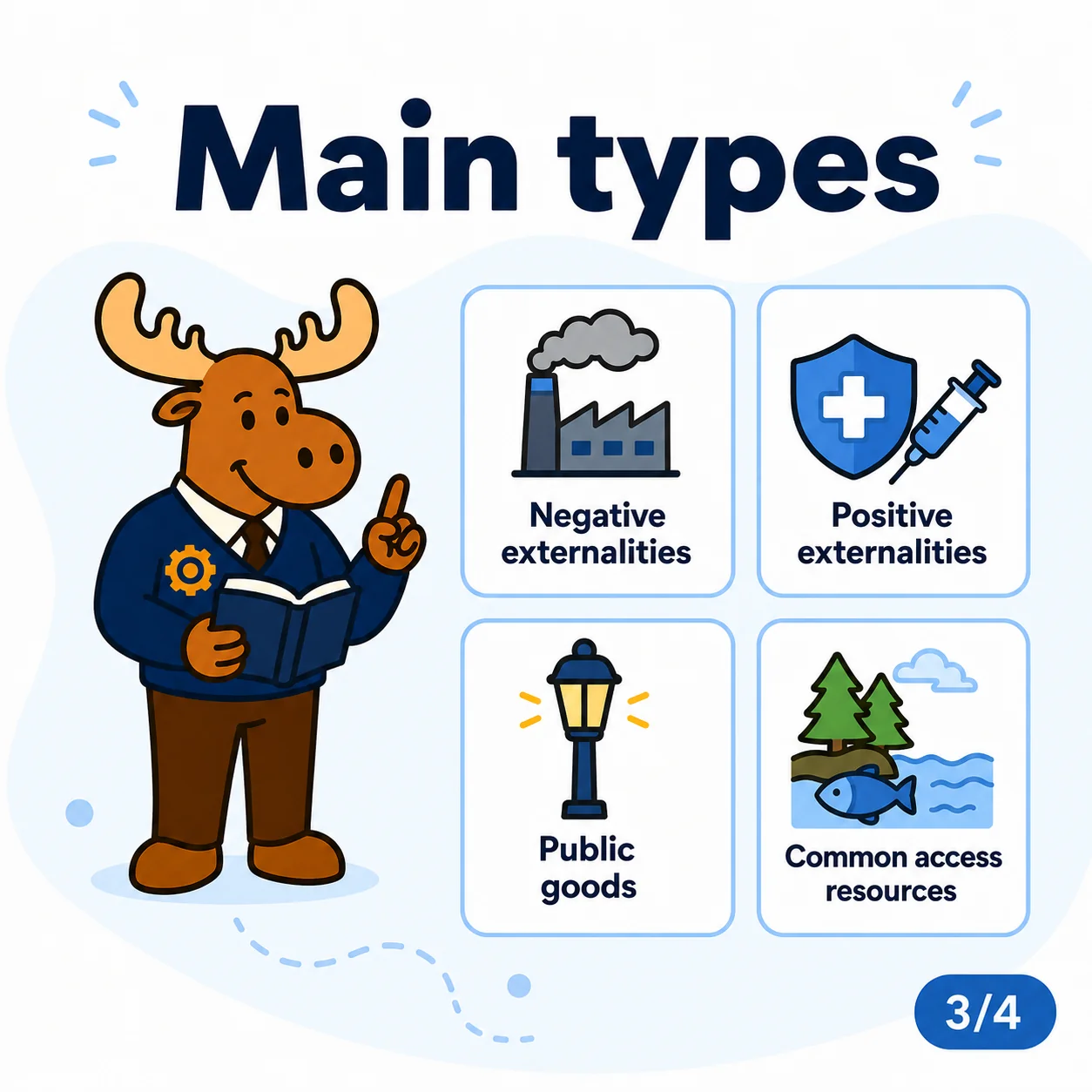
Common pool resources
Common pool resources are rivalrous but non-excludable, or difficult to exclude people from using. Examples include fish stocks, forests, clean air and shared water resources.
They are rivalrous because one person’s use reduces what is available for others. They are difficult to exclude people from because access may be hard to control.
This can create overuse. If individual users gain private benefits from exploiting the resource but do not bear the full social cost, they may use too much of it. This is sometimes described as the tragedy of the commons.
For example, if many fishing boats operate in open waters, each boat has an incentive to catch more fish. But if all boats do this, fish stocks may decline, damaging long-term welfare.
Common pool resources are closely linked to sustainability. The market may fail because short-term private incentives do not protect long-term social welfare.
Asymmetric information
Asymmetric information occurs when one party in a transaction has more or better information than the other.
This can cause market failure because buyers or sellers make decisions based on incomplete or inaccurate information.
For example, in a used car market, sellers may know more about the quality of a car than buyers. If buyers fear that many cars are low quality, they may only be willing to pay a low price. This can push high-quality sellers out of the market, reducing overall market efficiency.
In healthcare, consumers may not fully understand the risks, benefits or necessity of treatments. In financial markets, borrowers may know more about their repayment risk than lenders. In food markets, producers may know more about ingredients or production methods than consumers.
Government responses may include regulation, labelling requirements, quality standards, licensing, consumer protection laws and information campaigns.
This topic is developed in market failure and asymmetric information.
Market power
Market power occurs when a firm has the ability to influence price or output in a market. This can happen when there is monopoly power, high barriers to entry or limited competition.
In a competitive market, firms have less control over price and are pressured to keep costs low and respond to consumers. When a firm has market power, it may restrict output and charge a higher price than would occur under more competitive conditions.
This can lead to allocative inefficiency because the price consumers pay may be greater than marginal cost. Some consumers who value the good more than its cost of production may be excluded from the market, creating welfare loss.
Market power can also reduce consumer choice and weaken incentives for efficiency or innovation, although large firms may sometimes benefit from economies of scale or have resources for research and development.
A strong IB answer should evaluate both sides. Market power can create inefficiency, but the effect depends on the market, regulation, economies of scale and whether potential competition exists.
You can study this further in market failure and market power.
Equity and market outcomes
Markets may allocate resources efficiently in some cases, but still produce outcomes that society considers unfair. Equity refers to fairness in the distribution of income, wealth and opportunity.
A free market distributes goods and services mainly according to willingness and ability to pay. This can mean that low-income households cannot access important goods such as healthcare, education, housing or nutritious food at the same level as high-income households.
This is not always classified as allocative inefficiency in the narrow sense, but it is still a major reason for government intervention in IB Economics. Governments may use taxes, transfers, subsidies, minimum wages or direct provision to improve equity.
The key distinction is that efficiency and equity are not the same thing. A market outcome may be efficient but unequal. A policy that improves equity may also create efficiency costs. IB evaluation often depends on this trade-off.
This is covered in markets inability to achieve equity.
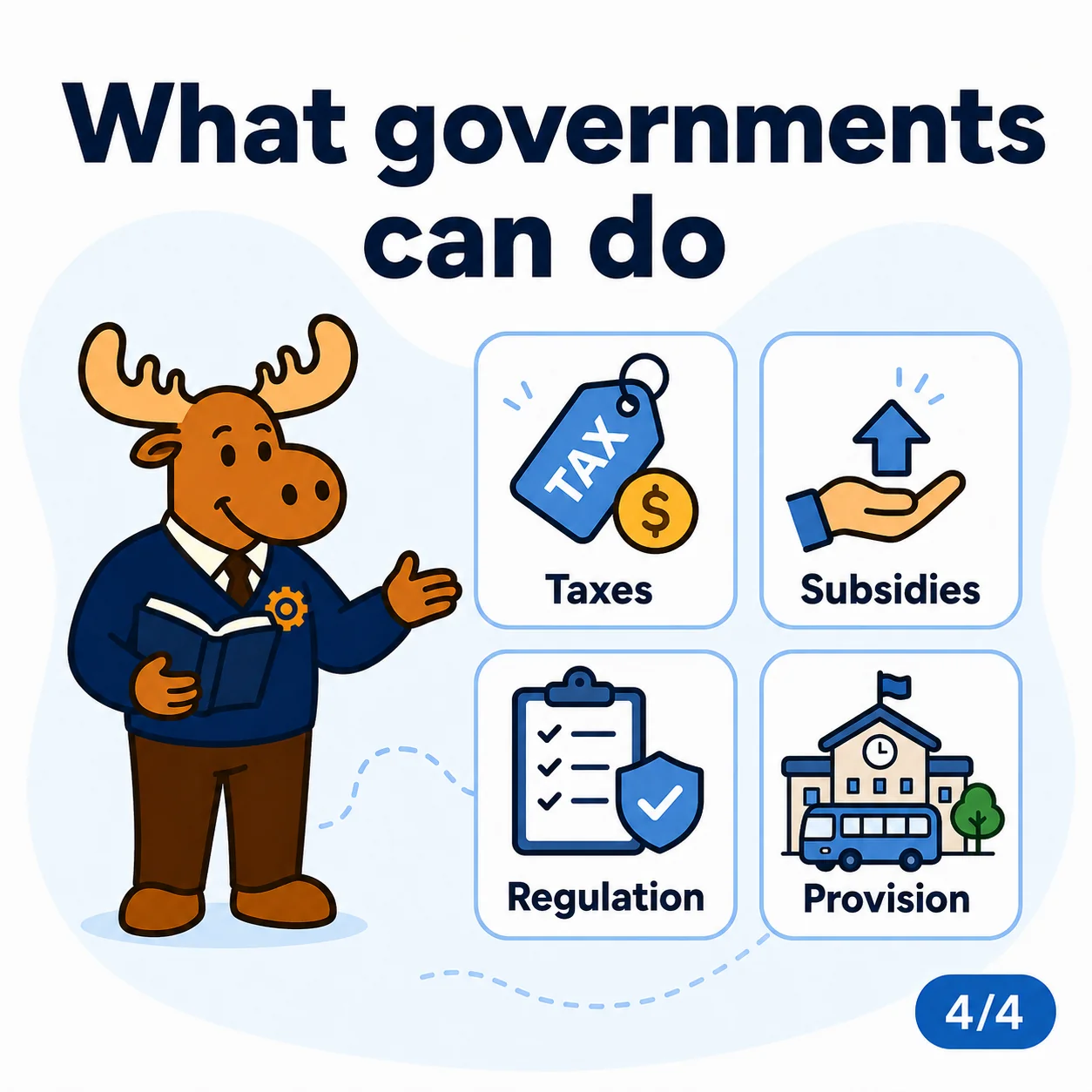
Government responses to market failure
Governments can respond to market failure in several ways. The correct policy depends on the cause of the failure.
For negative externalities, governments may use indirect taxes, regulation, tradable permits or information campaigns. A tax can raise producers’ costs, shifting the supply curve left. In a diagram with price on the vertical axis and quantity on the horizontal axis, this increases price and reduces quantity. If set equal to the external cost, the tax can move the market closer to the socially efficient output.
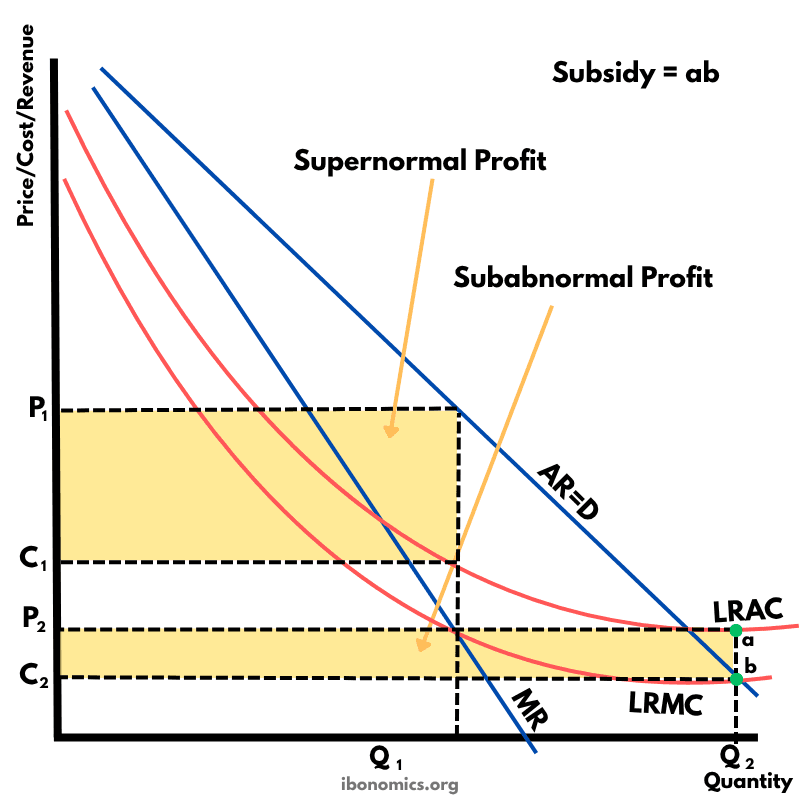
For positive externalities, governments may use subsidies, direct provision or information campaigns. A subsidy lowers production costs or reduces the price paid by consumers, encouraging greater consumption or production.
For public goods, direct government provision is often used because private firms may not be able to charge users effectively.
For asymmetric information, governments may require labelling, product standards, safety rules or professional qualifications.
For market power, governments may use competition policy, regulation, price controls or public ownership in some cases.
These policies are introduced in reasons for government intervention and forms of government intervention.
Government failure and policy trade-offs
Government intervention can improve market outcomes, but it does not automatically solve the problem. Government failure occurs when intervention leads to a less efficient or less desirable outcome than before.
This may happen because of poor information, administrative costs, unintended consequences, political pressure or difficulty setting the correct size of intervention.
For example, a pollution tax may reduce emissions, but if the tax is too low, pollution remains excessive. If the tax is too high, output may fall too much or firms may relocate. A subsidy for education may increase consumption, but it requires government spending and may have an opportunity cost. Regulation may improve safety, but it can raise firms’ costs and reduce competition if poorly designed.
This is why IB Economics expects evaluation. You should explain not only why the market fails, but also whether the proposed intervention is suitable, practical and proportionate.
IB exam relevance and common mistakes
Market failure is highly exam-relevant because it combines definitions, diagrams, welfare analysis, real-world examples and evaluation.
A strong answer should identify the type of market failure, explain why the free market outcome is inefficient, use the correct diagram where appropriate, and evaluate possible government responses.
A common mistake is saying that market failure means “prices are too high.” High prices alone do not prove market failure. A market fails when resources are allocated inefficiently or when the market outcome creates a welfare loss or serious equity concern.
Another common mistake is confusing private and social costs. Private costs are costs faced by producers or consumers directly involved in the transaction. Social costs include private costs plus external costs.
Students also sometimes draw externality diagrams without explaining the socially efficient output. In IB answers, you should clearly identify the free market quantity, the socially optimal quantity and the welfare loss.
Another mistake is assuming government intervention is always successful. Strong evaluation considers policy limitations, time lags, enforcement costs, stakeholder impacts and unintended consequences.
Real-world evaluation: market failure depends on context
Market failure is useful because it explains why markets may produce outcomes that are inefficient or socially undesirable. However, the size and seriousness of market failure depends on context.
Pollution from a small local business may create limited external costs, while emissions from a large coal power station may create significant social costs. Information problems may be minor in simple markets but serious in healthcare, finance or insurance. Market power may be harmful when it raises prices and restricts output, but less harmful if regulation is effective or if economies of scale lower average costs.
Government responses also depend on context. A tax may be effective if the good has elastic demand and emissions are measurable. Regulation may be better when behaviour must be stopped directly. Subsidies may be useful for goods with external benefits, but they require funding and may be poorly targeted.
This is why the best IB answers avoid one-size-fits-all conclusions. They explain the market failure clearly, then evaluate the likely effectiveness of intervention in that specific market.
Conclusion
Market failure occurs when free markets fail to allocate resources efficiently. This may happen because of externalities, public goods, common pool resources, asymmetric information, market power or inequitable outcomes.
The central IB idea is that private decision-making does not always maximise social welfare. Consumers and producers may ignore external costs or benefits, lack information, overuse shared resources, or face markets dominated by powerful firms.
Government intervention can improve outcomes through taxes, subsidies, regulation, direct provision and information policies. However, intervention also involves costs and trade-offs.
The strongest IB Economics answers explain the cause of market failure, use diagrams accurately, identify welfare effects and evaluate whether government intervention is likely to improve efficiency, equity or sustainability.
Related syllabus topics
Market Failure: Externalities and Common Pool Resources
Unit 2.8: Market Failure: Externalities and Common Pool Resources
Market Failure: Public Goods
Unit 2.9: Market Failure: Public Goods
Market Failure: Asymmetric Information
Unit 2.10: Market Failure: Asymmetric Information
Market Failure: Market Power
Unit 2.11: Market Failure: Market Power
The Market’s Inability to Achieve Equity
Unit 2.12: The Market’s Inability to Achieve Equity
Allocative Efficiency
Unit 2.3: Competitive Market Equilibrium