Externalities in IB Economics: Negative Externalities, Positive Externalities and Third-Party Effects
A clear IB Economics explanation of externalities, including negative externalities, positive externalities, third-party effects, welfare loss and government responses.
Externalities in IB Economics: Negative Externalities, Positive Externalities and Third-Party Effects
Externalities are one of the most important forms of market failure in IB Economics. They occur when the production or consumption of a good affects a third party who is not directly involved in the market transaction.
The key idea is that private decision-makers do not always consider the full social costs or benefits of their actions. A firm may consider its own production costs but ignore pollution affecting nearby communities. A consumer may consider the private benefit of education but not the wider benefits to society.
Externalities matter because they create a gap between the free market outcome and the socially efficient outcome. This means markets may produce too much or too little of a good from society’s point of view.
What is an externality?
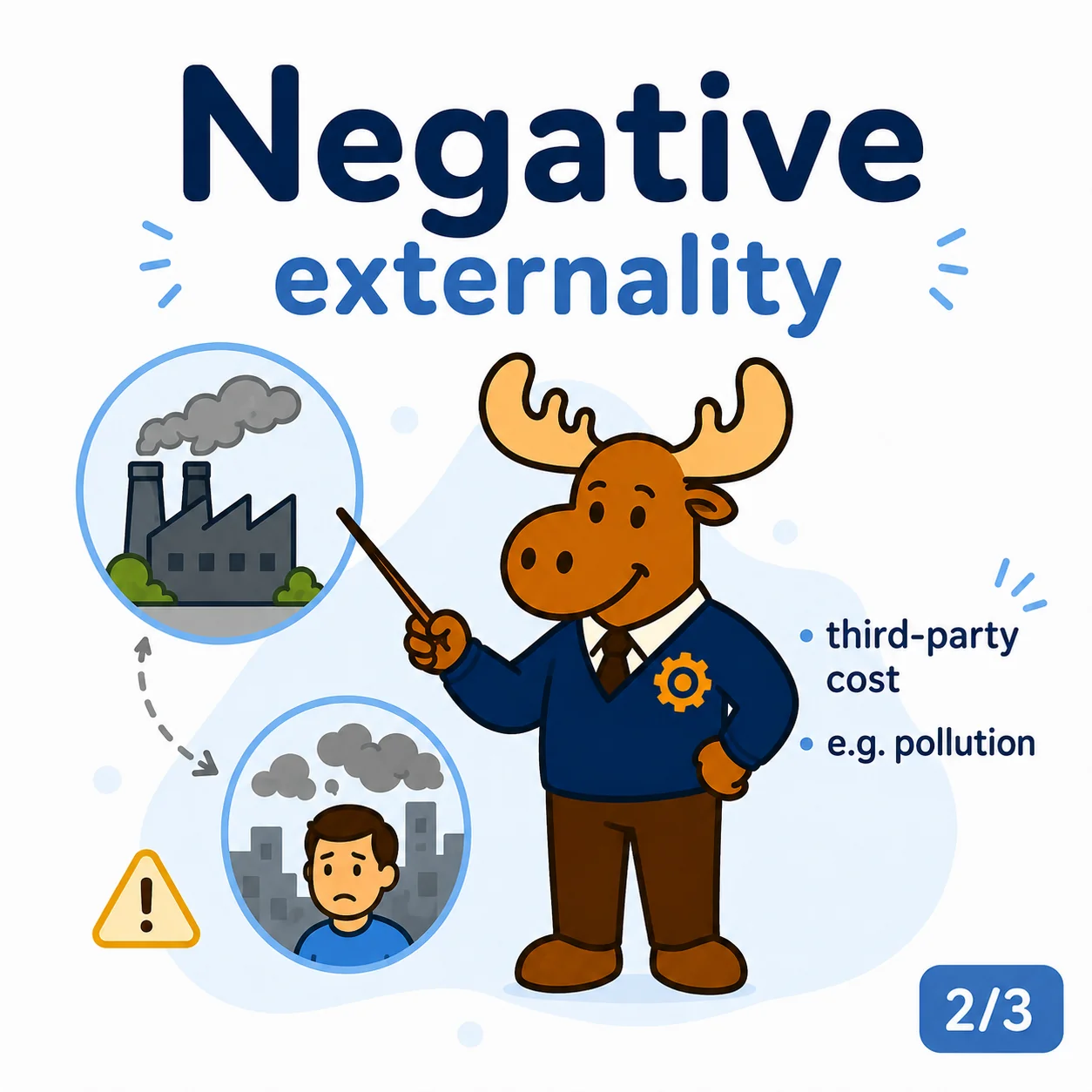
An externality is an external cost or benefit experienced by a third party as a result of production or consumption.
A third party is someone who is not directly involved in the buying or selling of the good. For example, if a factory sells electricity to consumers, the buyer and seller are the direct market participants. People living near the factory who experience air pollution are third parties.
Externalities can be negative or positive.
A negative externality occurs when production or consumption creates an external cost. This means the activity harms third parties.
A positive externality occurs when production or consumption creates an external benefit. This means the activity benefits third parties.
Externalities are a form of market failure because the free market does not fully account for these external costs or benefits. As a result, the market equilibrium is not allocatively efficient.
Private costs, social costs, private benefits and social benefits
To understand externalities, IB students need to distinguish between private and social values.
Private cost is the cost faced by the producer or consumer directly involved in the transaction. For a firm, this might include wages, raw materials, rent and energy bills.
External cost is the cost imposed on third parties. Pollution, traffic congestion, noise and environmental damage are common examples.
Social cost is the total cost to society. It includes private cost plus external cost.
Private benefit is the benefit received by the consumer or producer directly involved in the transaction. For example, a student receives private benefits from education through better job opportunities and personal knowledge.
External benefit is the benefit received by third parties. If education creates a more productive workforce or better civic participation, those wider benefits go beyond the individual student.
Social benefit is the total benefit to society. It includes private benefit plus external benefit.
This distinction is essential for externality diagrams because market failure occurs when marginal private cost or benefit differs from marginal social cost or benefit.
Negative externalities
A negative externality exists when production or consumption imposes a cost on third parties.
A negative production externality occurs when producing a good creates external costs. Pollution from factories, carbon emissions from electricity generation and chemical runoff from farming are common examples.
A negative consumption externality occurs when consuming a good creates external costs. Smoking, excessive alcohol consumption and traffic congestion from car use are common examples.
In both cases, the problem is that the market participants do not face the full social cost of their actions. They make decisions based on private costs and private benefits, while part of the cost is pushed onto others.
This means the free market produces or consumes too much of the good relative to the socially efficient level.
Negative production externality diagram
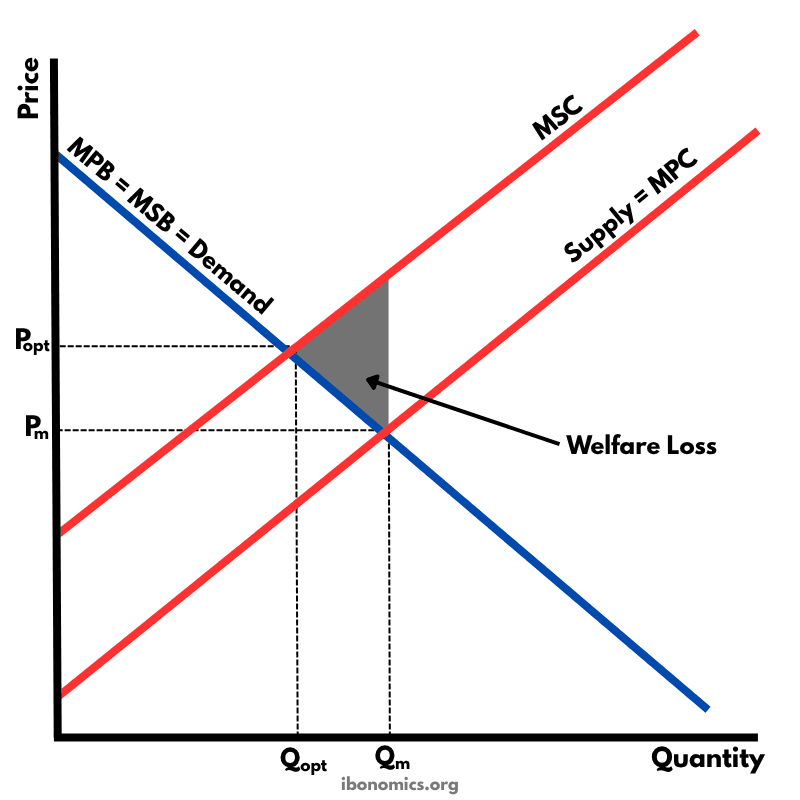
In a negative production externality diagram, the vertical axis shows costs and benefits, while the horizontal axis shows quantity.
The marginal private cost curve, MPC, shows the cost faced by producers. The marginal social cost curve, MSC, shows the full cost to society. Because production creates external costs, MSC lies above MPC.
The marginal social benefit curve, MSB, is often equal to marginal private benefit if there is no externality in consumption.
The free market equilibrium occurs where MPC equals MSB. This is where private decision-makers choose to produce and consume.
The socially efficient output occurs where MSC equals MSB. This is where the full social cost equals the social benefit.
Because MSC is above MPC, the free market quantity is greater than the socially efficient quantity. The good is overproduced. The welfare loss is shown by the area between MSC and MSB for the units produced beyond the socially efficient level.
The diagram helps explain why pollution-generating goods may be overproduced in a free market.
Negative consumption externality diagram
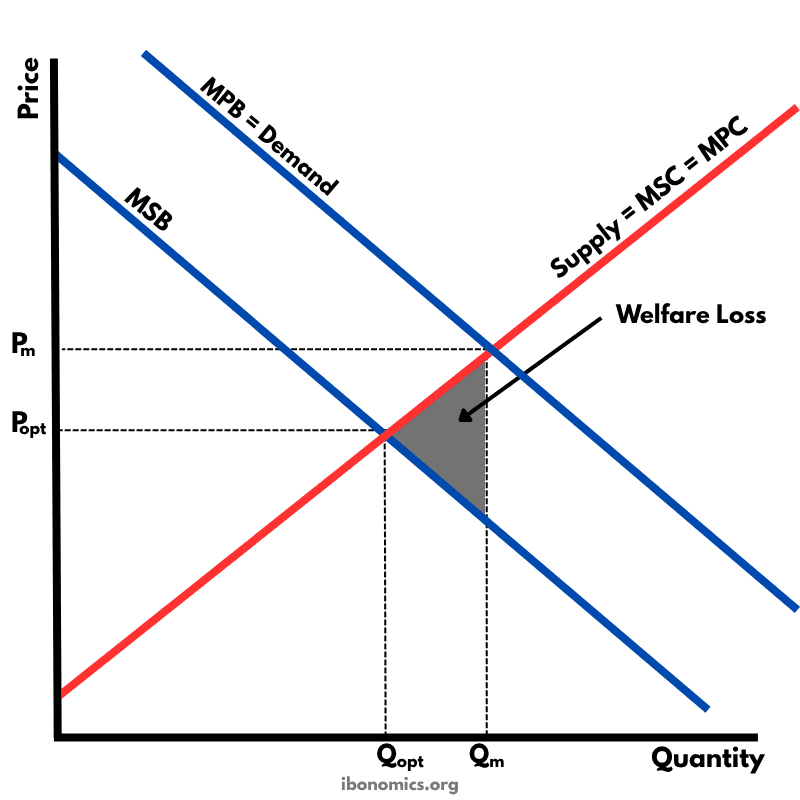
In a negative consumption externality diagram, the external cost comes from consumption rather than production.
The vertical axis still shows costs and benefits, and the horizontal axis shows quantity. The marginal private benefit curve, MPB, shows the benefit received by consumers. The marginal social benefit curve, MSB, lies below MPB because consumption creates external costs for third parties.
The marginal social cost curve, MSC, is often equal to marginal private cost if there is no externality in production.
The free market equilibrium occurs where MPB equals MSC. The socially efficient output occurs where MSB equals MSC.
Because MPB is above MSB, the free market quantity is greater than the socially efficient quantity. The good is overconsumed. The welfare loss occurs because some units are consumed where social cost is greater than social benefit.
This is commonly used to analyse goods such as cigarettes, alcohol, fossil fuel consumption or private car use in congested areas.
Positive externalities
A positive externality exists when production or consumption creates benefits for third parties.
A positive production externality occurs when producing a good creates external benefits. For example, research and development by one firm may generate knowledge spillovers that benefit other firms.
A positive consumption externality occurs when consuming a good creates external benefits. Education, vaccinations and some healthcare services are common examples.
In these cases, the market participants do not capture the full social benefit of the good. Consumers or producers base decisions on private benefits, while part of the benefit goes to society more broadly.
This means the free market produces or consumes too little of the good relative to the socially efficient level.

Positive consumption externality diagram
Positive consumption externalities are especially common in IB Economics examples.
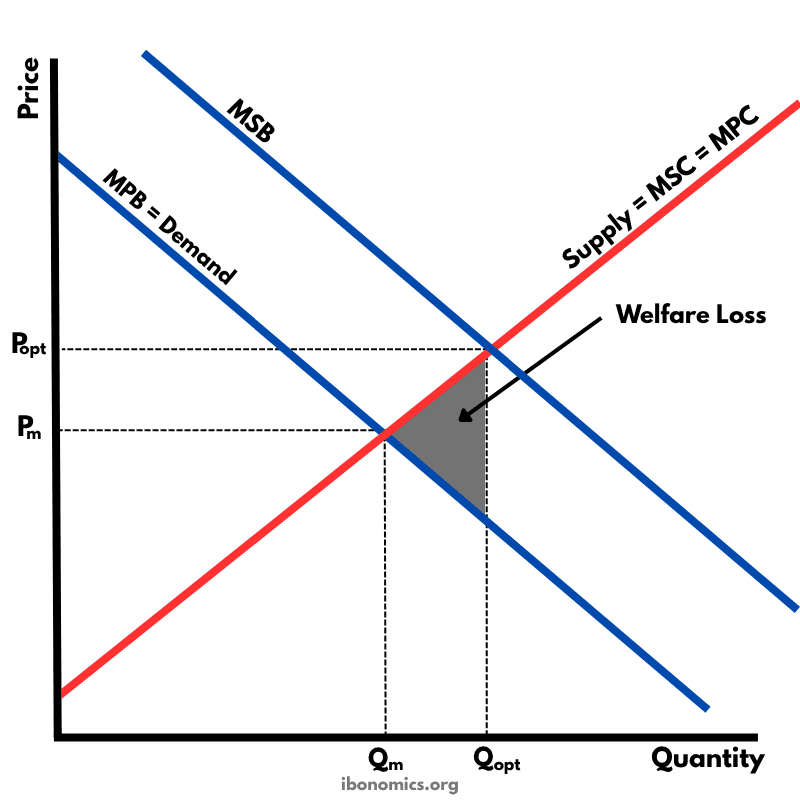
In the diagram, the vertical axis shows costs and benefits, and the horizontal axis shows quantity. The marginal private benefit curve, MPB, shows the benefit received by consumers. The marginal social benefit curve, MSB, lies above MPB because consumption creates external benefits.
The marginal social cost curve, MSC, is often equal to marginal private cost if there is no production externality.
The free market equilibrium occurs where MPB equals MSC. The socially efficient output occurs where MSB equals MSC.
Because MSB is above MPB, the free market quantity is lower than the socially efficient quantity. The good is underconsumed. The welfare loss occurs because some units are not consumed even though their social benefit is greater than their social cost.
Education is a strong example. A student may consider the private benefit of better employment, but society may also benefit from higher productivity, lower crime, better health outcomes and stronger civic participation.
Positive production externality diagram
A positive production externality occurs when production creates external benefits for third parties.
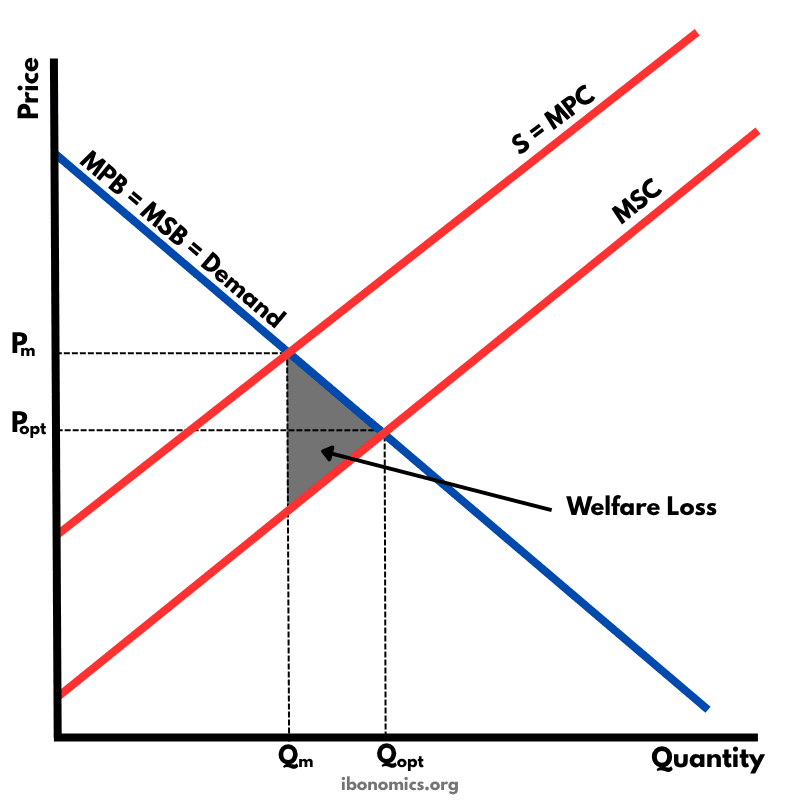
In this diagram, the marginal social cost curve lies below the marginal private cost curve. This is because the external benefit reduces the net cost to society.
The free market equilibrium occurs where marginal private cost equals marginal social benefit. The socially efficient output occurs where marginal social cost equals marginal social benefit.
Because MSC is below MPC, the free market quantity is lower than the socially efficient quantity. The good is underproduced.
Research and development is a common example. A firm may invest in innovation for private profit, but other firms, consumers and society may benefit from knowledge spillovers. If the firm cannot capture all of those benefits, the market may provide less research and development than is socially optimal.
Externalities and allocative efficiency
Externalities create allocative inefficiency because the market equilibrium does not occur where marginal social benefit equals marginal social cost.
In a market without externalities, private costs and benefits may reflect social costs and benefits. In that case, the free market can move toward allocative efficiency.
With externalities, private decision-making leads to the wrong level of output from society’s perspective.
Negative externalities create overproduction or overconsumption because the market ignores external costs. Positive externalities create underproduction or underconsumption because the market ignores external benefits.
This creates a welfare loss. Welfare loss means a loss of social community surplus compared with the socially efficient outcome.
Government responses to negative externalities
Governments may intervene to reduce negative externalities. The aim is to move the market closer to the socially efficient level of output.
An indirect tax can be used to make producers or consumers face more of the external cost. For a negative production externality, a tax raises firms’ costs of production. In a demand and supply diagram with price on the vertical axis and quantity on the horizontal axis, this shifts the supply curve left. Price rises and quantity falls.
If the tax is equal to the external cost, it can internalise the externality. This means the private cost becomes closer to the social cost.
Governments may also use regulation. For example, they can set emissions limits, ban harmful substances or require firms to use cleaner technology. Regulation can be effective when the activity is very harmful, but it may be costly to enforce and may reduce flexibility for firms.
Information campaigns can also reduce negative consumption externalities by changing consumer behaviour. For example, anti-smoking campaigns may reduce demand by making consumers more aware of external and private costs.
These policies connect to indirect taxes and direct provision and regulation.
Government responses to positive externalities
Governments may intervene to increase the consumption or production of goods with positive externalities. The aim is to move output closer to the socially efficient level.
A subsidy lowers the cost of production or reduces the price paid by consumers. In a standard demand and supply diagram, a subsidy shifts the supply curve right. Price paid by consumers falls and quantity increases.
For goods such as education or healthcare, governments may also use direct provision. This means the government provides the good itself, either free or at a subsidised price. This can increase access and consumption.
Information campaigns may also encourage consumption of goods with positive externalities. For example, public health campaigns can encourage vaccination or preventive healthcare.
The main idea is that positive externalities cause underconsumption or underproduction, so government policy often tries to increase output.
You can review this through subsidies and reasons for government intervention.
IB exam relevance and common mistakes
Externalities are highly exam-relevant because they combine definitions, diagrams, welfare analysis, real-world examples and evaluation.
A strong answer should identify the type of externality, explain the third-party effect, distinguish private and social costs or benefits, draw the correct diagram, identify the welfare loss and evaluate possible government responses.
A common mistake is forgetting the third party. If only the buyer or seller is affected, it is not an externality. The effect must fall on someone outside the direct transaction.
Another common mistake is confusing negative externalities with high prices. A high price does not automatically mean there is a negative externality. The key issue is whether there is an external cost ignored by the market.
Students also sometimes confuse negative production and negative consumption externalities. In a production externality, the cost comes from producing the good, so MSC is above MPC. In a consumption externality, the cost comes from consuming the good, so MSB is below MPB.
For positive externalities, students often forget that the market outcome is too low. Positive externalities lead to underproduction or underconsumption because private decision-makers do not capture the full social benefit.
Finally, avoid saying that a tax or subsidy always solves the problem. Government intervention may reduce welfare loss, but its success depends on the size of the externality, information quality, enforcement, elasticity and possible unintended consequences.
Evaluation: externalities are difficult to measure
Externalities are useful for explaining market failure, but they can be difficult to measure in practice.
For a tax to fully correct a negative externality, the government would need to know the exact size of the external cost. This is difficult. The social cost of pollution, congestion or poor health may vary across locations, time periods and affected groups.
Subsidies also require careful design. If a subsidy is too small, underconsumption may remain. If it is too large, the good may be overconsumed, or government funds may be wasted. Subsidies also have an opportunity cost because the money could have been used elsewhere.
Regulation can be effective, but it may be expensive to monitor and enforce. Firms may also find ways around the rules or pass higher costs on to consumers.
This is why IB evaluation should consider information problems, government failure, stakeholder impacts and time periods. Externality diagrams show the logic clearly, but real-world policy decisions are rarely perfect.
Conclusion
Externalities occur when production or consumption affects third parties. Negative externalities create external costs and usually lead to overproduction or overconsumption. Positive externalities create external benefits and usually lead to underproduction or underconsumption.
The central IB idea is that private costs and benefits may differ from social costs and benefits. When this happens, the free market outcome is not allocatively efficient and welfare loss occurs.
Government intervention can reduce market failure through taxes, subsidies, regulation, direct provision and information campaigns. However, policy success depends on measurement, enforcement, elasticities, costs and unintended consequences.
The strongest IB Economics answers explain the third-party effect clearly, use the correct externality diagram and evaluate whether intervention is likely to move the market closer to the socially efficient outcome.
Related syllabus topics
Market Failure: Externalities and Common Pool Resources
Unit 2.8: Market Failure: Externalities and Common Pool Resources
Socially Optimum Output (MSB = MSC)
Unit 2.8: Market Failure: Externalities and Common Pool Resources
Positive Externalities of Production and Consumption
Unit 2.8: Market Failure: Externalities and Common Pool Resources
Negative Externalities of Production and Consumption
Unit 2.8: Market Failure: Externalities and Common Pool Resources
Merit and Demerit Goods
Unit 2.8: Market Failure: Externalities and Common Pool Resources
Government Responses to Externalities
Unit 2.8: Market Failure: Externalities and Common Pool Resources