Price Elasticity of Supply: How Responsive Producers Are to Price Changes
A clear IB Economics explanation of price elasticity of supply, including elastic and inelastic supply, determinants of PES and why producer responsiveness matters.
Price Elasticity of Supply: How Responsive Producers Are to Price Changes
Price elasticity of supply, usually shortened to PES, measures how responsive producers are to a change in price. It helps economists understand how quickly and strongly firms can increase or decrease output when market conditions change.
In IB Microeconomics, PES is important because it connects producer behaviour to market outcomes. When demand rises, the final effect on price and quantity depends partly on how easily firms can expand production. If supply is elastic, producers can respond quickly. If supply is inelastic, output changes only slightly, and prices may rise more sharply.
PES is therefore useful for analysing firms, markets, government intervention and real-world supply problems such as housing shortages, agricultural production, energy markets and manufacturing capacity.
The definition of price elasticity of supply
Price elasticity of supply measures the responsiveness of quantity supplied to a change in price, ceteris paribus.
The formula is:
PES = percentage change in quantity supplied divided by percentage change in price
Unlike price elasticity of demand, PES is usually positive. This is because price and quantity supplied normally move in the same direction. According to the law of supply, when price rises, quantity supplied usually rises. When price falls, quantity supplied usually falls.
For example, if the price of a good rises by 10 percent and quantity supplied rises by 20 percent, PES is 2. This means supply is price elastic because producers respond proportionally more than the price change.
The key idea is simple: PES tells us how flexible producers are.
What PES measures
PES measures responsiveness along a supply curve. A change in the price of the good itself causes a movement along the supply curve, not a shift of the supply curve.
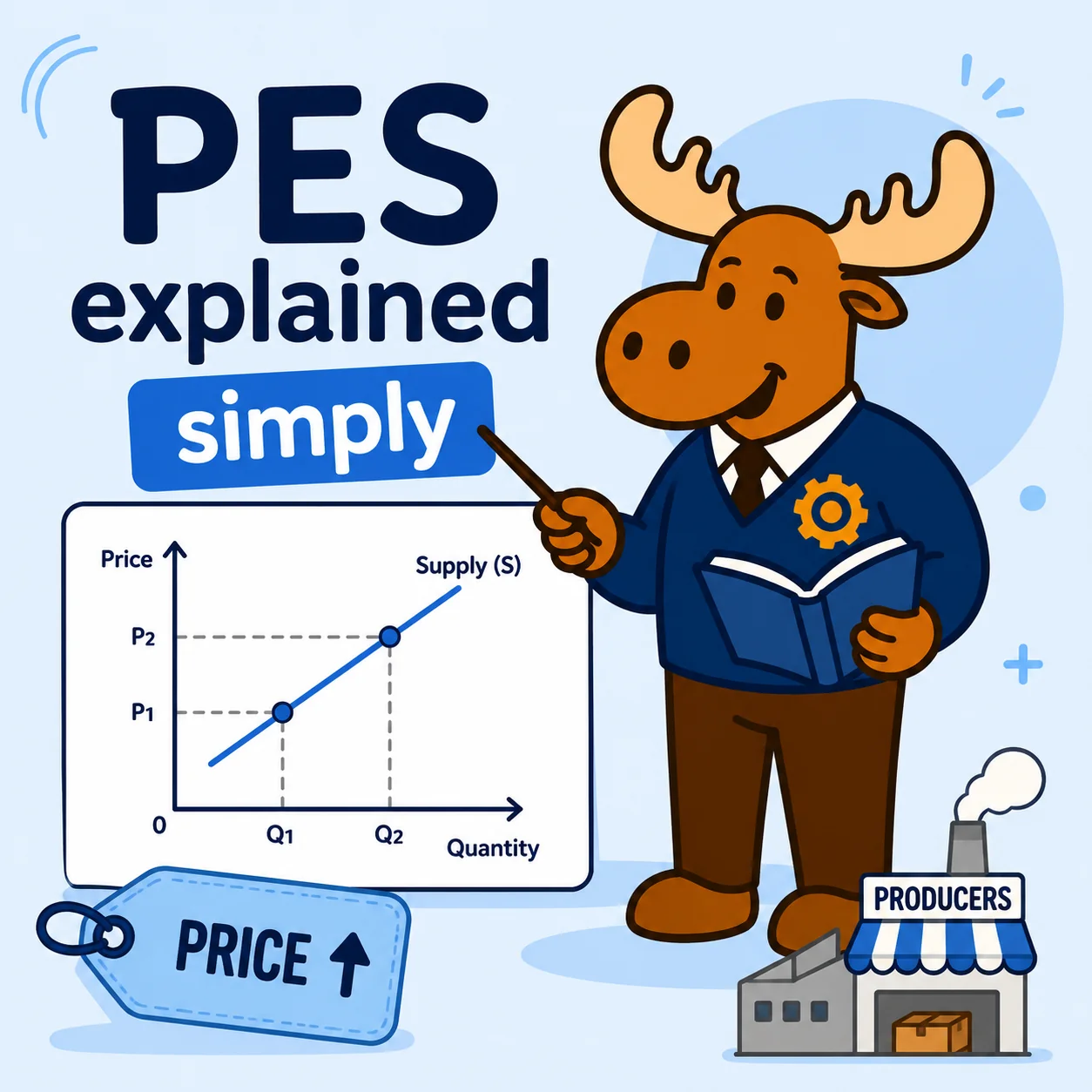
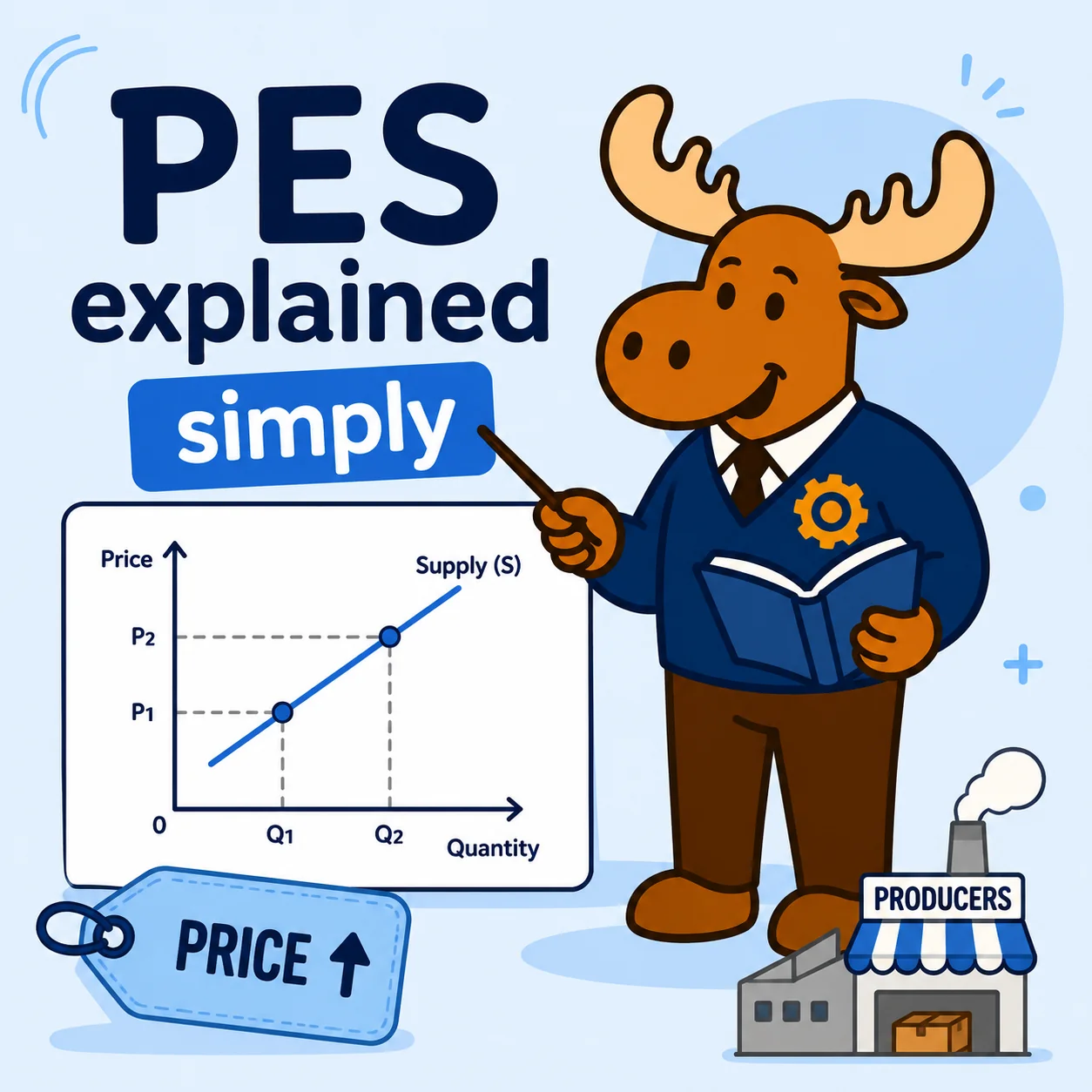
In a supply diagram, price is on the vertical axis and quantity is on the horizontal axis. The supply curve usually slopes upward because a higher price gives producers an incentive to supply more output, assuming other factors stay the same.
If price rises, there is an extension of supply: movement up along the supply curve. If price falls, there is a contraction of supply: movement down along the supply curve.
PES measures how large that movement in quantity supplied is relative to the change in price. It does not measure what happens when production costs, technology, indirect taxes, subsidies or the number of firms changes. Those factors shift supply instead.
You can connect this to the supply curve and the full elasticity of supply unit.

Elastic and inelastic supply
Supply is price elastic when quantity supplied responds proportionally more than price. This means PES is greater than 1.
For example, if price rises by 10 percent and quantity supplied rises by 30 percent, supply is elastic. Producers can increase output strongly in response to the price change.
Supply is price inelastic when quantity supplied responds proportionally less than price. This means PES is less than 1.
For example, if price rises by 10 percent and quantity supplied rises by 4 percent, supply is inelastic. Producers are not able to increase output much, even though the higher price gives them an incentive to do so.
Unit elastic supply occurs when quantity supplied changes by the same proportion as price. PES equals 1.
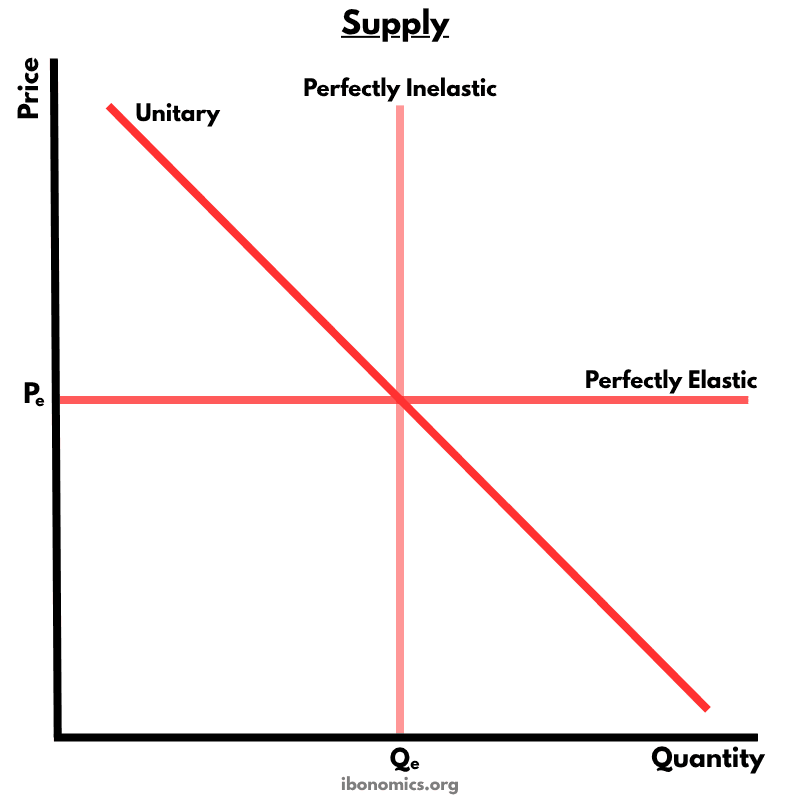
Perfectly elastic and perfectly inelastic supply are special cases. Perfectly elastic supply is shown as a horizontal supply curve, where producers are willing to supply any quantity at one price but none below it. Perfectly inelastic supply is shown as a vertical supply curve, where quantity supplied does not change when price changes.
Most real-world examples fall between these extremes, so IB answers usually focus on relatively elastic or relatively inelastic supply.
Determinants of PES
The price elasticity of supply for a good depends on how easily producers can adjust output. This is why time, spare capacity, factor mobility and storage are central determinants.
Time is one of the most important factors. In the short run, supply is often more inelastic because firms may not be able to hire workers, buy machinery or expand production quickly. In the long run, supply tends to become more elastic because firms have more time to adjust.
Spare capacity also matters. If firms have unused factories, machines or workers, they can increase production more easily when price rises. Supply is therefore more elastic. If firms are already operating close to full capacity, output cannot rise much without major investment, so supply is more inelastic.
The mobility of factors of production affects PES too. If land, labour and capital can be moved easily from one use to another, producers can respond more quickly. For example, a clothing factory may switch between similar garments more easily than a farm can switch from growing wheat to producing oranges.
The ability to store goods also matters. If a good can be stored without losing value, producers can respond to price rises by releasing stock. Supply is more elastic. If a good is perishable, such as fresh fish or strawberries, supply is usually more inelastic in the short run.
You can explore these factors in the determinants of PES.
PES and supply diagrams
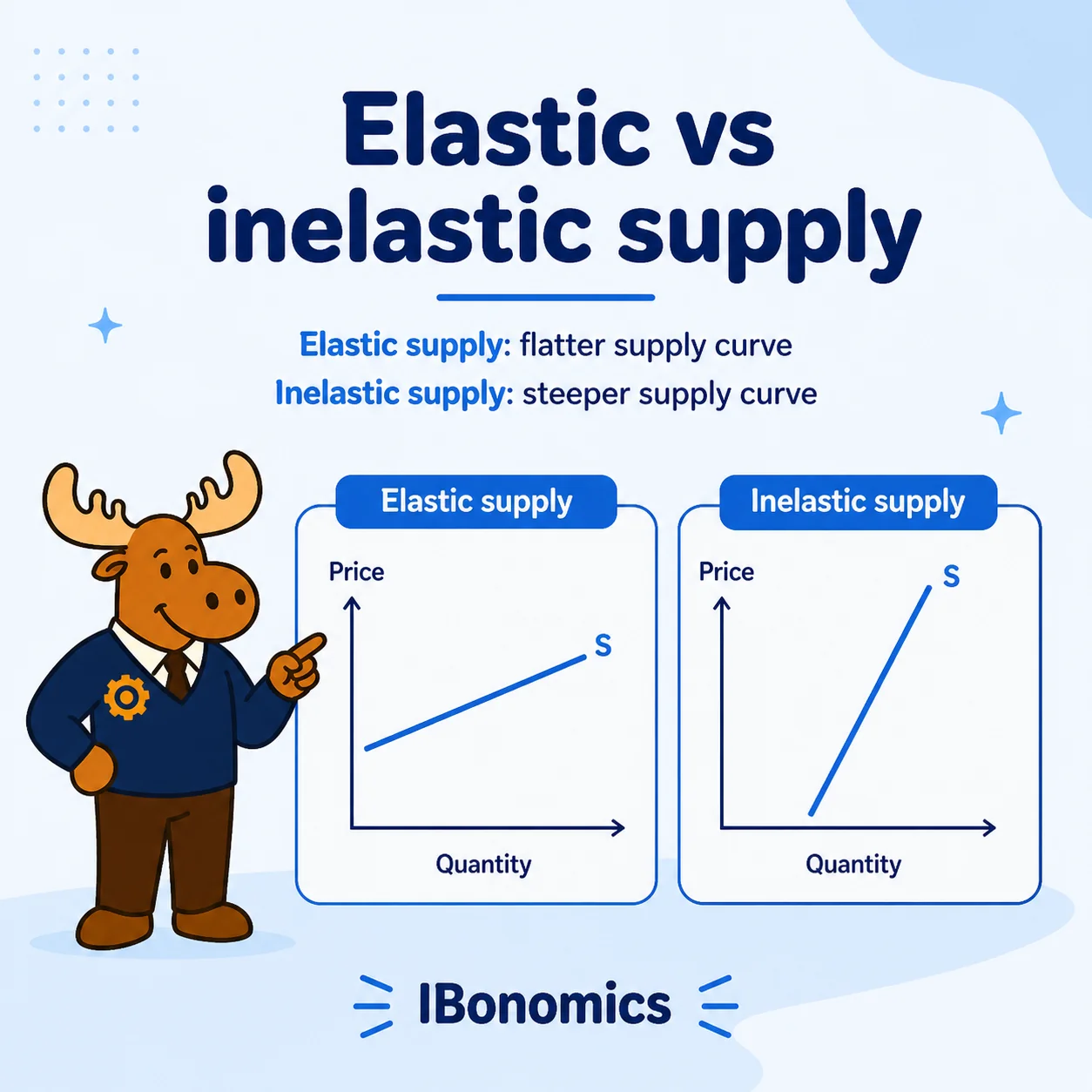
PES can be shown using supply curves with different steepness. A relatively elastic supply curve is flatter. This means a change in price leads to a proportionally large change in quantity supplied.
A relatively inelastic supply curve is steeper. This means a change in price leads to a proportionally small change in quantity supplied.
In a diagram, price is on the vertical axis and quantity is on the horizontal axis. If demand increases, the demand curve shifts right. The supply curve does not shift because the cause of the change is demand, not a supply determinant.
When supply is elastic, the rightward shift of demand causes a relatively large increase in quantity and a smaller increase in price. Producers can expand output, so the market adjusts mainly through quantity.
When supply is inelastic, the same rightward shift of demand causes a larger increase in price and a smaller increase in quantity. Producers cannot expand output easily, so the market adjusts mainly through price.
This is a powerful exam point because PES affects how strongly demand shocks influence consumers, producers and market prices.
You can review diagram examples in PES diagrams for relatively elastic and inelastic supply.
PES and calculation
To calculate PES, divide the percentage change in quantity supplied by the percentage change in price.
For example, suppose the price of a good rises from $10 to $12. This is a 20 percent increase. If quantity supplied rises from 100 units to 130 units, this is a 30 percent increase.
PES = 30 percent divided by 20 percent = 1.5
Because PES is greater than 1, supply is price elastic.
In IB answers, the calculation is only the first step. The interpretation matters more. A PES of 1.5 means producers are relatively responsive to price changes. A PES of 0.4 means producers are relatively unresponsive.
Students should also be careful with units. PES is a ratio of percentage changes, so it has no unit. It is not measured in dollars, kilograms or units of output.
For more practice, see PES formula and calculation and degrees of PES.
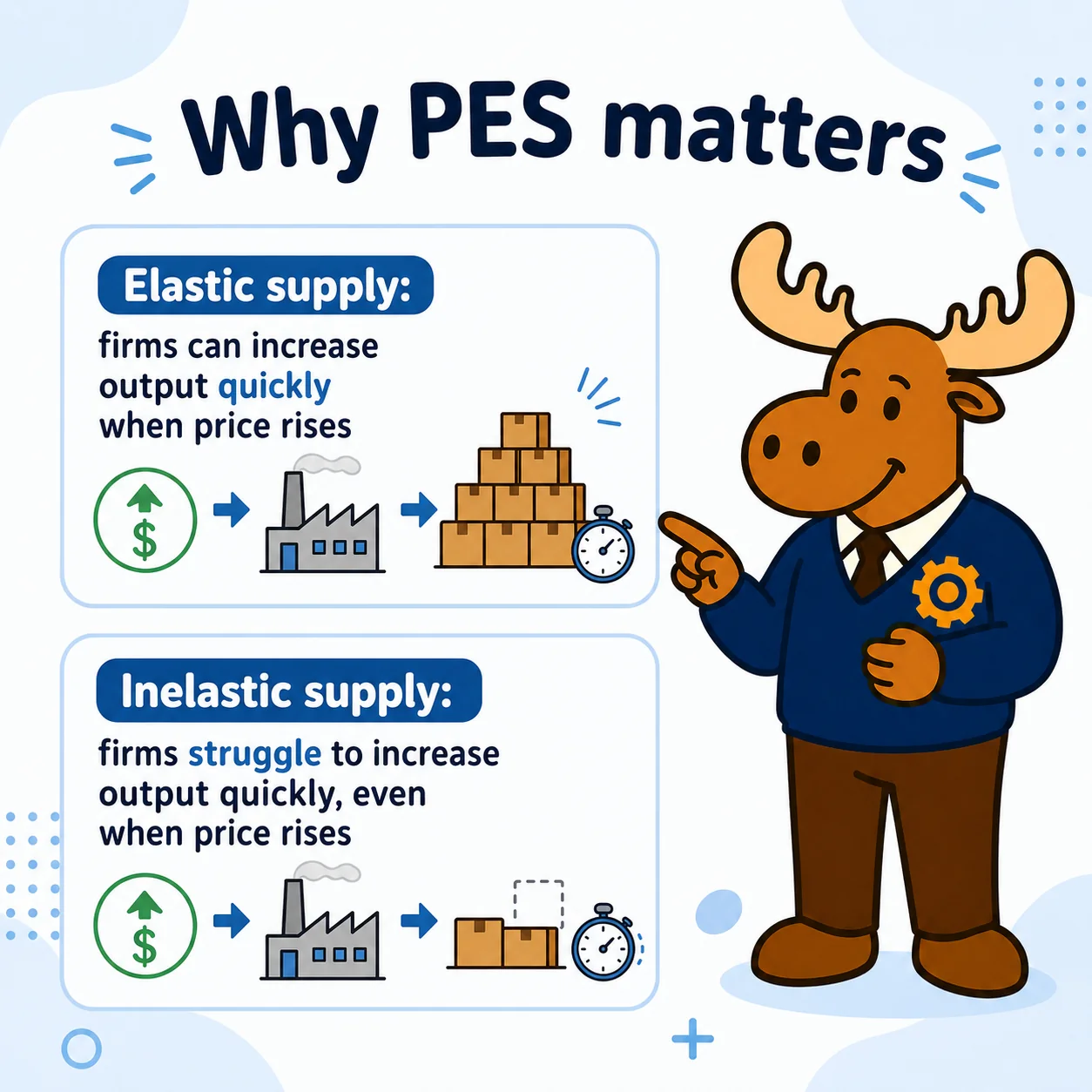
Why PES matters for firms
PES matters for firms because it affects how quickly they can benefit from higher prices. If market demand increases and price rises, firms with elastic supply can expand output quickly and increase revenue. Firms with inelastic supply may miss some of the opportunity because they cannot produce much more in the short run.
For example, a software company may have relatively elastic supply once the product has been developed, because selling additional downloads or subscriptions can be done at low marginal cost. A housebuilder may have more inelastic supply because land, planning permission, labour and construction time limit how quickly new homes can be supplied.
PES also affects business planning. Firms may invest in spare capacity, flexible production systems or better inventory management to make supply more responsive. However, this can be costly. Holding spare capacity may reduce efficiency if demand does not rise.
This creates a trade-off between flexibility and cost.
Why PES matters for governments
Governments use PES when analysing taxes, subsidies, housing policy, agricultural markets and infrastructure planning.
If the supply of housing is price inelastic, rising demand may mainly increase house prices rather than the number of homes. This can create affordability problems. In that case, policies may need to address planning restrictions, land availability, construction capacity or infrastructure, not just consumer demand.
If the supply of food is inelastic in the short run, a poor harvest can sharply increase prices because farmers cannot quickly replace lost output. This can affect consumer welfare, especially for low-income households that spend a large share of income on food.
PES also matters for indirect taxes and subsidies. If supply is inelastic, producers cannot easily reduce output or leave the market. The burden of a tax or the benefit of a subsidy may be distributed differently depending on the relative elasticities of demand and supply.
For IB evaluation, PES helps explain why the same policy can have different effects in different markets.
IB exam relevance and common mistakes
PES is exam-relevant because it appears in definitions, calculations, diagrams and evaluation questions. A strong answer should define PES, apply the formula correctly, classify the value and explain what it means for producers and market outcomes.
A common mistake is confusing PES with PED. PED measures consumer responsiveness to price changes. PES measures producer responsiveness to price changes.
Another common mistake is forgetting that PES measures movement along the supply curve. If the price of the good itself changes, quantity supplied changes along the existing supply curve. If production costs, technology, taxes or subsidies change, the supply curve shifts instead.
Students also sometimes say that inelastic supply means quantity supplied does not change. This is only true for perfectly inelastic supply. Normally, inelastic supply means quantity supplied changes proportionally less than price.
Another issue is diagram explanation. It is not enough to draw a steep or flat supply curve. You should explain what happens to price and quantity when demand changes. With elastic supply, quantity adjusts more. With inelastic supply, price adjusts more.
Finally, students should avoid treating PES as fixed forever. Supply may be inelastic in the short run but more elastic in the long run as firms invest, hire workers or enter the market.
Evaluation: PES depends heavily on context
PES is useful because it shows how producer responsiveness affects market adjustment. However, it depends heavily on the market, time period and production conditions.
Agricultural goods often have inelastic supply in the short run because crops take time to grow and depend on weather. Manufactured goods may have more elastic supply if firms have spare capacity and can access inputs quickly. Services vary widely. A streaming platform can expand access rapidly, while healthcare services may be limited by the number of trained doctors and nurses.
PES also changes over time. In the very short run, producers may be unable to change output at all. In the short run, they may use overtime or existing stock. In the long run, they can invest in new factories, train workers or enter new markets.
This means IB answers should avoid one-size-fits-all claims. Instead, evaluate the likely PES using specific evidence about time, spare capacity, factor mobility, storage and barriers to entry.
Conclusion
Price elasticity of supply measures how responsive quantity supplied is to a change in price. If supply is elastic, producers can adjust output strongly. If supply is inelastic, output changes only slightly.
PES matters because it affects how markets respond to changes in demand, taxes, subsidies and shocks. It helps explain why some markets adjust mainly through quantity, while others adjust mainly through price.
The strongest IB answers define PES accurately, interpret calculated values, use diagrams clearly and evaluate producer responsiveness using time, spare capacity, factor mobility and storage.
Related syllabus topics
Elasticity of Supply
Unit 2.6: Elasticity of Supply
Price Elasticity of Supply (PES)
Unit 2.6: Elasticity of Supply
PES Formula and Calculation
Unit 2.6: Elasticity of Supply
Degrees of PES
Unit 2.6: Elasticity of Supply
Determinants of PES
Unit 2.6: Elasticity of Supply
PES Diagrams (Relatively Elastic and Inelastic Supply)
Unit 2.6: Elasticity of Supply