Price Controls in IB Economics: Price Ceilings, Price Floors, Shortages and Surpluses
A clear IB Economics explanation of price controls, including price ceilings, price floors, shortages, surpluses and stakeholder effects.
Price Controls in IB Economics: Price Ceilings, Price Floors, Shortages and Surpluses
Price controls are government interventions that legally restrict how high or low prices can be in a market. They are used when governments believe the free market price creates problems for consumers, producers, workers or society.
In IB Microeconomics, price controls are important because they show how government intervention can change market outcomes. A price ceiling can make a good more affordable, but it may create a shortage. A price floor can support producers or workers, but it may create a surplus or unemployment.
The key IB skill is to explain both the intended goal and the unintended consequences. Price controls are not simply good or bad. Their effects depend on where they are set, how elastic demand and supply are, how governments enforce them, and which stakeholders are affected.
What price controls are
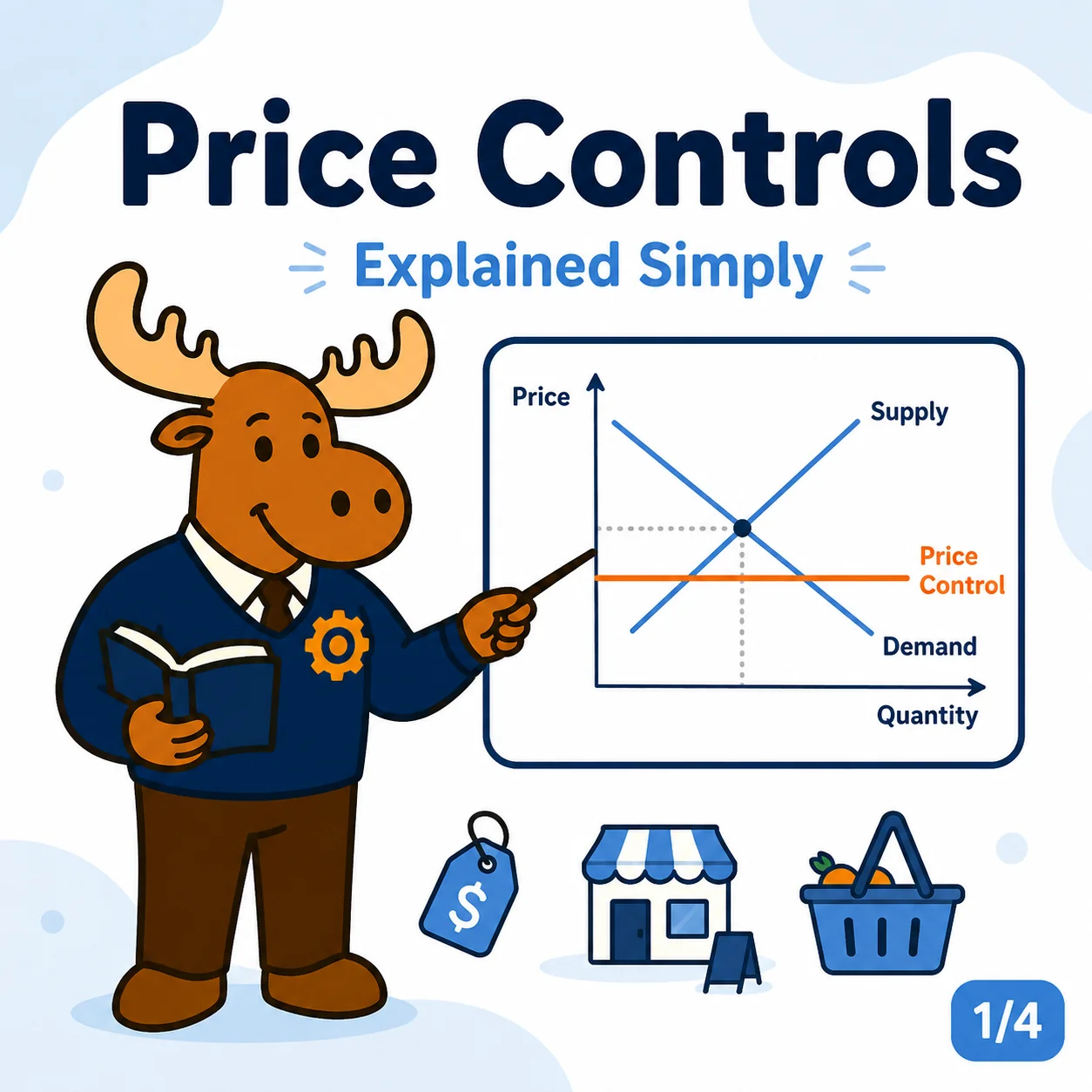
A price control is a legal restriction on the price that can be charged in a market. Governments usually use price controls when they believe the free market outcome is undesirable.
There are two main types: price ceilings and price floors.
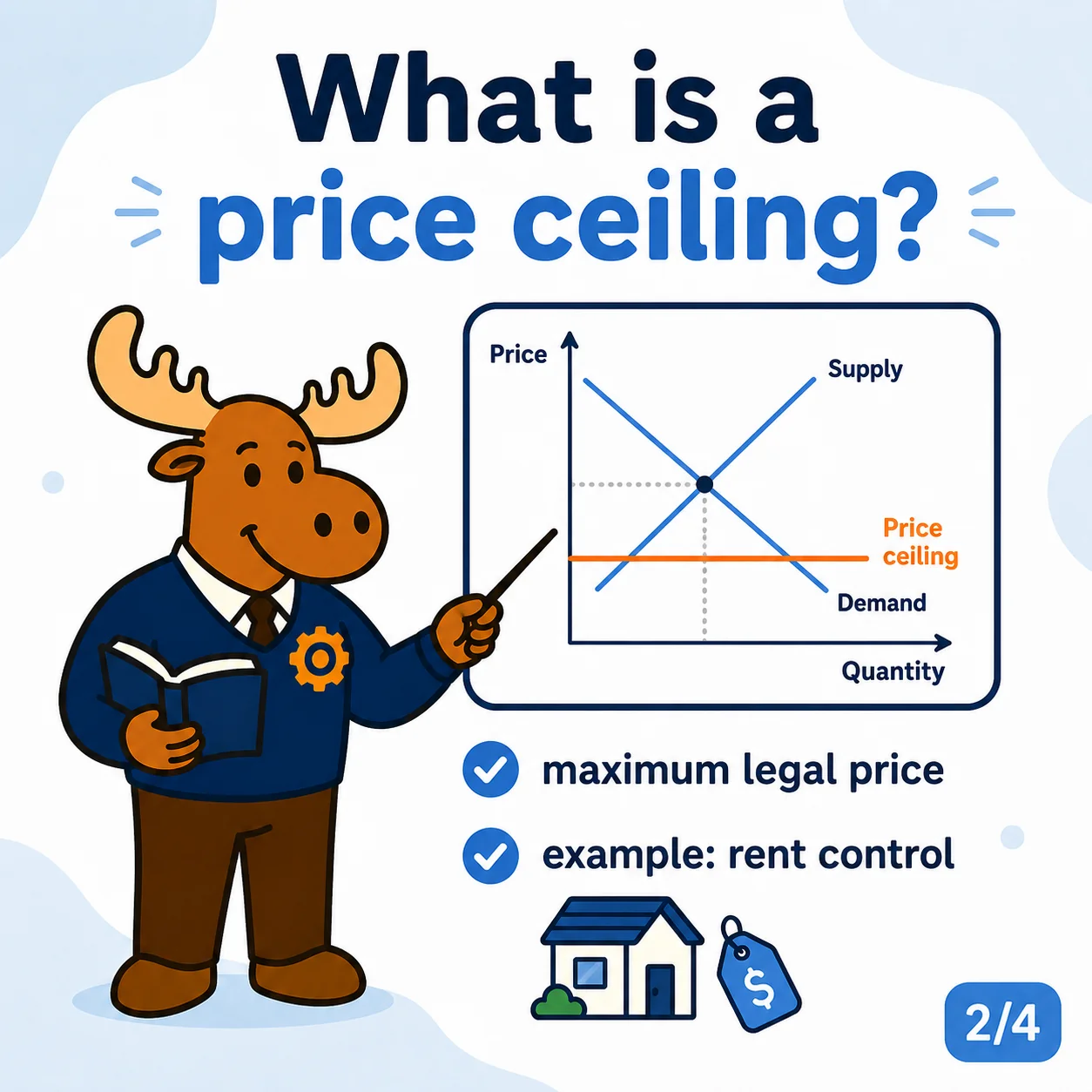
A price ceiling is a maximum legal price. Sellers are not allowed to charge above this price. It is usually used to make essential goods more affordable for consumers, such as rent, food, fuel or medicine.
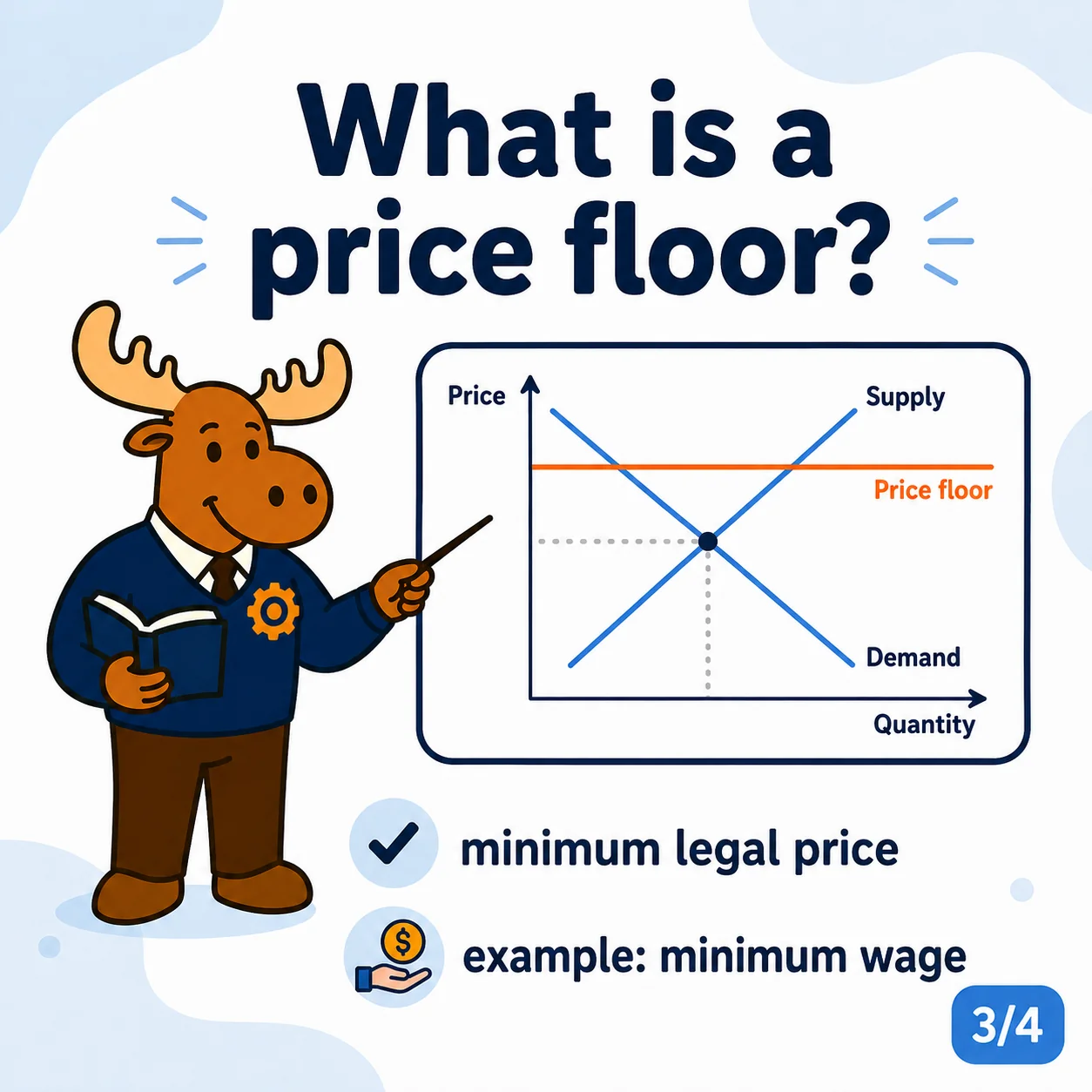
A price floor is a minimum legal price. Sellers are not allowed to charge below this price. It is usually used to support producers or workers, such as farmers receiving minimum prices for agricultural goods or workers receiving a minimum wage.
Price controls are part of government intervention in microeconomics and are covered directly in price controls.
The market equilibrium starting point
Before analysing a price control, you need to understand the free market equilibrium. In a demand and supply diagram, price is on the vertical axis and quantity is on the horizontal axis.
The demand curve slopes downward because of the law of demand: as price falls, quantity demanded rises, ceteris paribus. The supply curve slopes upward because of the law of supply: as price rises, quantity supplied rises, ceteris paribus.
Market equilibrium occurs where quantity demanded equals quantity supplied. At this price, there is no shortage or surplus. The market clears.
A price control changes this outcome only if it is binding. A binding price ceiling is set below the equilibrium price. A binding price floor is set above the equilibrium price.
This matters because a maximum price above equilibrium or a minimum price below equilibrium has no direct effect on the market price. It does not restrict behaviour because the free market price is already within the legal limit.
For a deeper foundation, see market equilibrium.
Price ceilings: maximum prices
A price ceiling is a maximum legal price that sellers cannot exceed. It is usually introduced to protect consumers from prices that the government considers too high.
For a price ceiling to affect the market, it must be set below the equilibrium price. If it is set above equilibrium, the market price can still settle at equilibrium, so the ceiling is not binding.
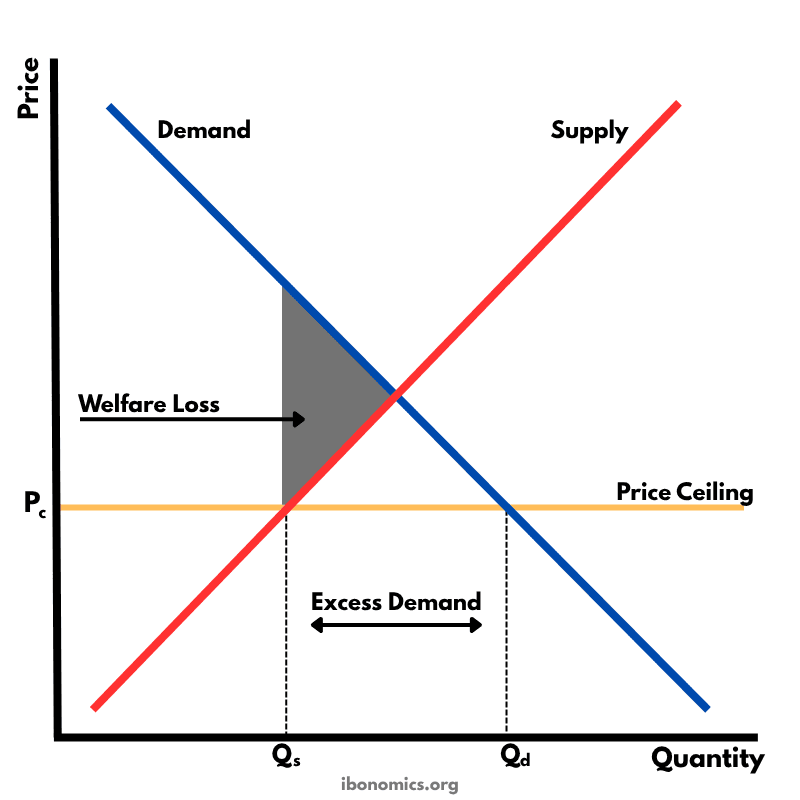
When a binding price ceiling is set below equilibrium, the price falls. At the lower price, quantity demanded increases because consumers want to buy more. At the same time, quantity supplied decreases because producers have less incentive to produce and sell the good.
This creates a shortage. Quantity demanded is greater than quantity supplied.
In a diagram, the vertical axis shows price and the horizontal axis shows quantity. The price ceiling is shown as a horizontal line below the equilibrium price. At this controlled price, the distance between quantity demanded and quantity supplied represents the shortage.
Why price ceilings create shortages
A shortage occurs because the controlled price is too low to balance demand and supply. Consumers want more of the good at the lower price, but producers are willing and able to supply less.
For example, rent controls may make housing more affordable for tenants who successfully rent a controlled apartment. However, at the lower rent, more people may want to rent, while landlords may supply fewer rental properties or invest less in maintenance. The result can be excess demand for housing.
This does not mean every tenant benefits equally. Some tenants may gain lower rents, but others may be unable to find housing at all. Non-price rationing may emerge, such as waiting lists, informal payments, discrimination, or allocation based on personal connections.
There may also be a black market if buyers are willing to pay more than the legal maximum and sellers are willing to break the law. This is one reason enforcement matters.
A strong IB answer should explain both the intended benefit and the shortage created by the price ceiling.
Price floors: minimum prices
A price floor is a minimum legal price that sellers cannot go below. It is usually introduced to support producers, workers or incomes.
For a price floor to affect the market, it must be set above the equilibrium price. If it is set below equilibrium, the market price can still settle at equilibrium, so the floor is not binding.
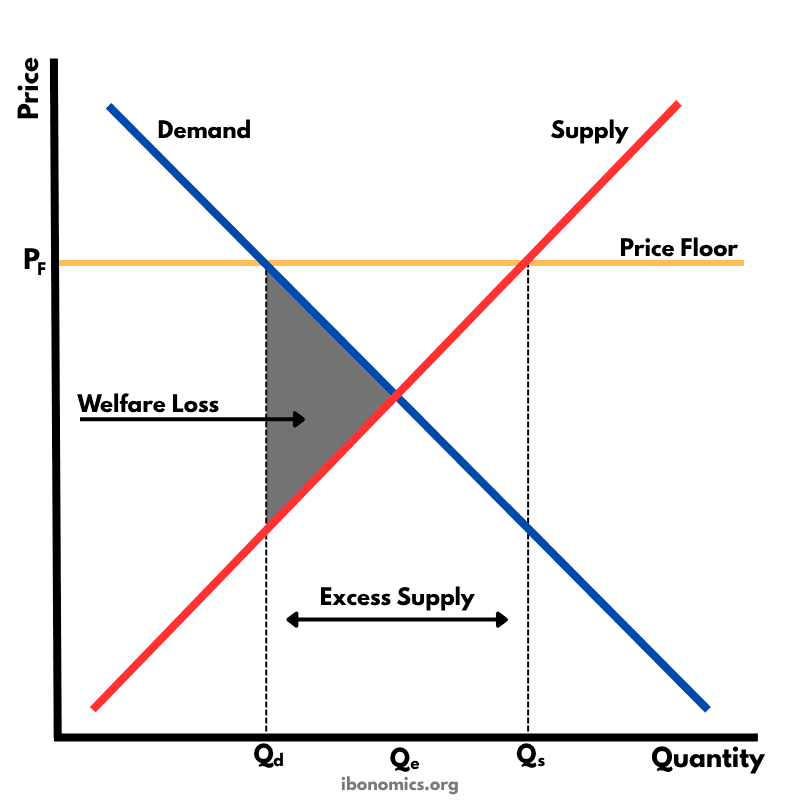
When a binding price floor is set above equilibrium, the price rises. At the higher price, quantity supplied increases because producers want to sell more. At the same time, quantity demanded decreases because consumers buy less.
This creates a surplus. Quantity supplied is greater than quantity demanded.
In a diagram, the vertical axis shows price and the horizontal axis shows quantity. The price floor is shown as a horizontal line above the equilibrium price. At this controlled price, the distance between quantity supplied and quantity demanded represents the surplus.
Why price floors create surpluses
A surplus occurs because the controlled price is too high to balance demand and supply. Producers want to supply more at the higher price, but consumers want to buy less.
For example, an agricultural price floor may be used to support farmers’ incomes. If the government sets a minimum price above equilibrium, farmers have an incentive to produce more, while consumers buy less. The result is excess supply.
The government may then need to buy the surplus, store it, export it or dispose of it. This can be expensive and may create opportunity costs because government funds could have been used elsewhere.
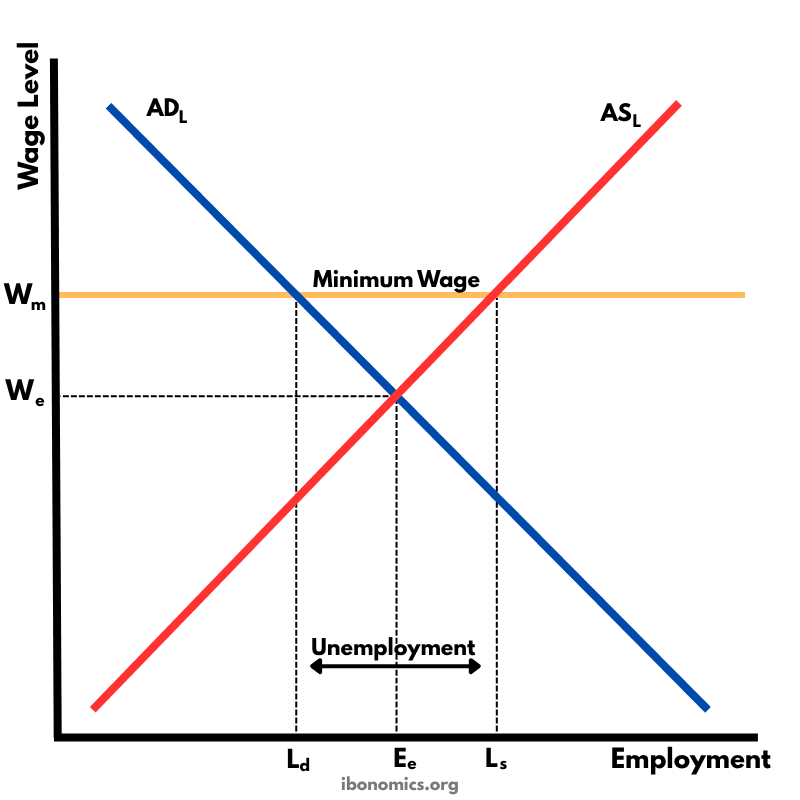
In labour markets, a minimum wage can be analysed as a price floor for labour. If set above the equilibrium wage, it may increase incomes for workers who keep their jobs, but it may also create unemployment if the quantity of labour supplied exceeds the quantity demanded by firms.
However, evaluation is important. If employers have market power, or if higher wages increase productivity and reduce worker turnover, the employment effect may be smaller than a simple diagram suggests.
Main effects on stakeholders
Price controls affect different stakeholders in different ways. This makes them useful for IB evaluation.
Consumers may benefit from a price ceiling if they can buy the good at the lower legal price. However, some consumers lose out if shortages mean they cannot access the good. They may also face lower quality, waiting times or black market prices.
Producers usually lose from a price ceiling because they receive a lower price and sell a smaller quantity. This may reduce revenue and reduce incentives to invest or maintain quality.
Producers may benefit from a price floor if they sell the good at a higher price. However, if a surplus occurs, not all producers may be able to sell their output unless the government purchases the excess supply.
Governments may gain political support by appearing to protect consumers or producers, but they may also face enforcement costs, storage costs, administrative costs and unintended consequences.
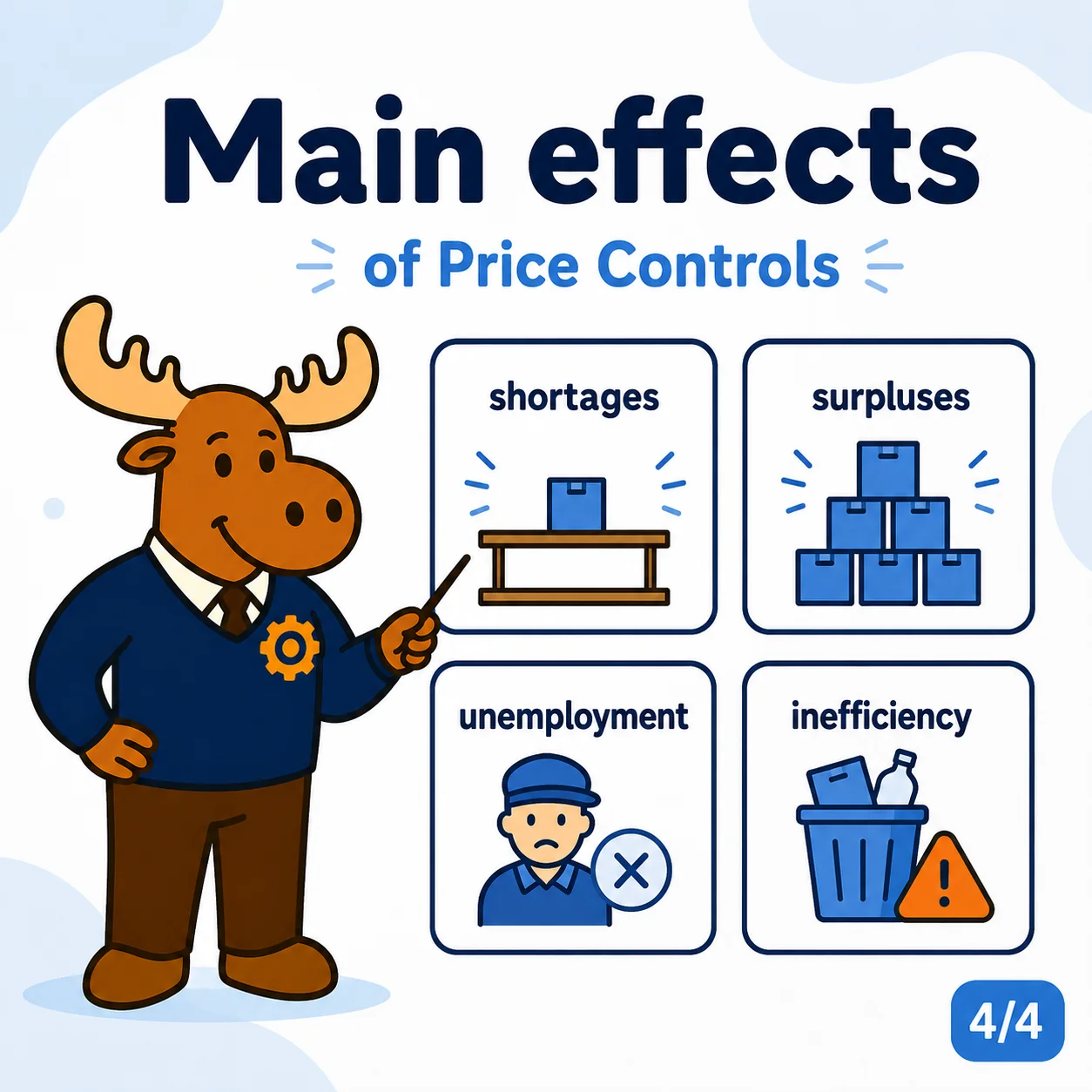
Society may experience welfare loss because price controls prevent the market from reaching the equilibrium where quantity demanded equals quantity supplied. Some mutually beneficial transactions no longer occur.
The broader effects are explored in consequences for markets and stakeholders.
Price ceilings and welfare effects
A binding price ceiling can create a welfare loss because the quantity traded falls below the free market equilibrium quantity. Some consumers who value the good more than the cost of producing it may not be able to buy it.
Consumer surplus may increase for consumers who successfully buy the good at the lower price. However, consumer surplus may fall for consumers who are rationed out of the market. Producer surplus usually falls because producers receive a lower price and sell less.
The total effect depends on how the shortage is allocated. If the good goes to consumers who value it most, the welfare loss may be smaller. If it is allocated randomly, through waiting lists or through unfair access, the outcome may be less efficient and less equitable.
A price ceiling can also reduce quality. If landlords receive lower rents, they may spend less on maintenance. If fuel prices are capped, suppliers may reduce service quality or limit supply.
This is why price ceilings may improve affordability for some consumers but worsen availability and quality.
Price floors and welfare effects
A binding price floor can also create a welfare loss because quantity demanded falls below the free market equilibrium quantity. Some transactions that would have occurred at the market equilibrium no longer take place.
Producer surplus may increase for producers who sell at the higher price. However, producers who cannot sell their output may lose. Consumer surplus falls because consumers pay a higher price and buy less.
If the government buys surplus output, producers may benefit more, but taxpayers bear the cost. Storage and disposal may create additional costs. If surplus goods are exported, this may affect producers in other countries.
In labour markets, a minimum wage may increase incomes for employed workers but reduce employment opportunities for others if the wage is above equilibrium. The final effect depends on labour demand elasticity, labour supply elasticity, productivity effects and the structure of the labour market.
This is why price floors require careful evaluation rather than a simple conclusion.
Price controls versus other interventions
Price controls are only one form of government intervention. Governments may also use taxes, subsidies, regulation, direct provision, buffer stock schemes or information campaigns.
For example, if housing is too expensive, a rent ceiling may reduce rents for some tenants but create shortages. An alternative policy could be subsidising housing construction, relaxing planning restrictions, building public housing or offering targeted housing benefits.
If farmer incomes are unstable, a price floor may support prices but create surpluses. Alternative policies could include income support, crop insurance, investment in productivity or direct subsidies.
The best policy depends on the goal. If the government wants affordability, a price ceiling may help some consumers but reduce supply. If the government wants higher producer income, a price floor may help some producers but reduce consumption and create excess supply.
You can compare price controls with other forms of government intervention.
IB exam relevance and common mistakes
Price controls are highly exam-relevant because they combine definitions, diagrams, market equilibrium, welfare effects and stakeholder evaluation.
A strong answer should define the price control, show whether it is binding, explain the effect on quantity demanded and quantity supplied, identify the shortage or surplus, and evaluate stakeholder impacts.
A common mistake is drawing a price ceiling above equilibrium. A price ceiling only creates a shortage if it is below equilibrium. If it is above equilibrium, it is not binding.
Another common mistake is drawing a price floor below equilibrium. A price floor only creates a surplus if it is above equilibrium. If it is below equilibrium, it is not binding.
Students also sometimes confuse demand and quantity demanded. With a price ceiling, the lower price causes an increase in quantity demanded, not an increase in demand. The demand curve does not shift. Consumers move along the existing demand curve.
Similarly, with a price floor, the higher price causes an increase in quantity supplied, not an increase in supply. The supply curve does not shift. Producers move along the existing supply curve.
Another common mistake is saying that price controls always help the group they are intended to protect. A rent ceiling may help tenants who find housing, but hurt tenants who cannot. A minimum wage may help workers who keep their jobs, but hurt workers who become unemployed or cannot find work.
Real-world evaluation: price controls depend on context
Price controls can be politically attractive because they appear direct and simple. If prices are too high, set a maximum. If incomes are too low, set a minimum. However, markets respond to incentives, so the final outcome may be more complicated.
The effectiveness of a price ceiling depends on how far it is set below equilibrium, how elastic demand and supply are, and whether the government can prevent black markets or quality reductions. If supply is very inelastic in the short run, a price ceiling may create a severe shortage. If the government combines the ceiling with policies to increase supply, the negative effects may be reduced.
The effectiveness of a price floor depends on how far it is set above equilibrium, whether the government buys surplus output, and how responsive consumers and producers are. If demand is price inelastic, the fall in quantity demanded may be small. If demand is elastic, the surplus may be much larger.
This is why IB evaluation should consider time periods, elasticities, enforcement, unintended consequences and stakeholder effects.
Conclusion
Price controls are legal limits on prices. A price ceiling is a maximum price, usually designed to protect consumers. If it is set below equilibrium, it creates a shortage. A price floor is a minimum price, usually designed to support producers or workers. If it is set above equilibrium, it creates a surplus.
The diagrams are straightforward, but the evaluation is more complex. Price controls can help some stakeholders while harming others. They may improve affordability or income support, but they can also create shortages, surpluses, welfare losses, black markets, quality problems and government costs.
The strongest IB Economics answers explain the diagram carefully, distinguish movements along curves from shifts of curves, and evaluate whether the intervention improves welfare in the specific market.
Related syllabus topics
Role of Government in Microeconomics
Unit 2.7: Role of Government in Microeconomics
Forms of Government Intervention
Unit 2.7: Role of Government in Microeconomics
Price Controls
Unit 2.7: Role of Government in Microeconomics
Consequences for Markets and Stakeholders
Unit 2.7: Role of Government in Microeconomics