Income Elasticity of Demand: Normal Goods, Inferior Goods, Luxuries and Necessities
A clear IB Economics explanation of income elasticity of demand, including normal goods, inferior goods, luxuries, necessities and why YED matters.
Income Elasticity of Demand: Normal Goods, Inferior Goods, Luxuries and Necessities
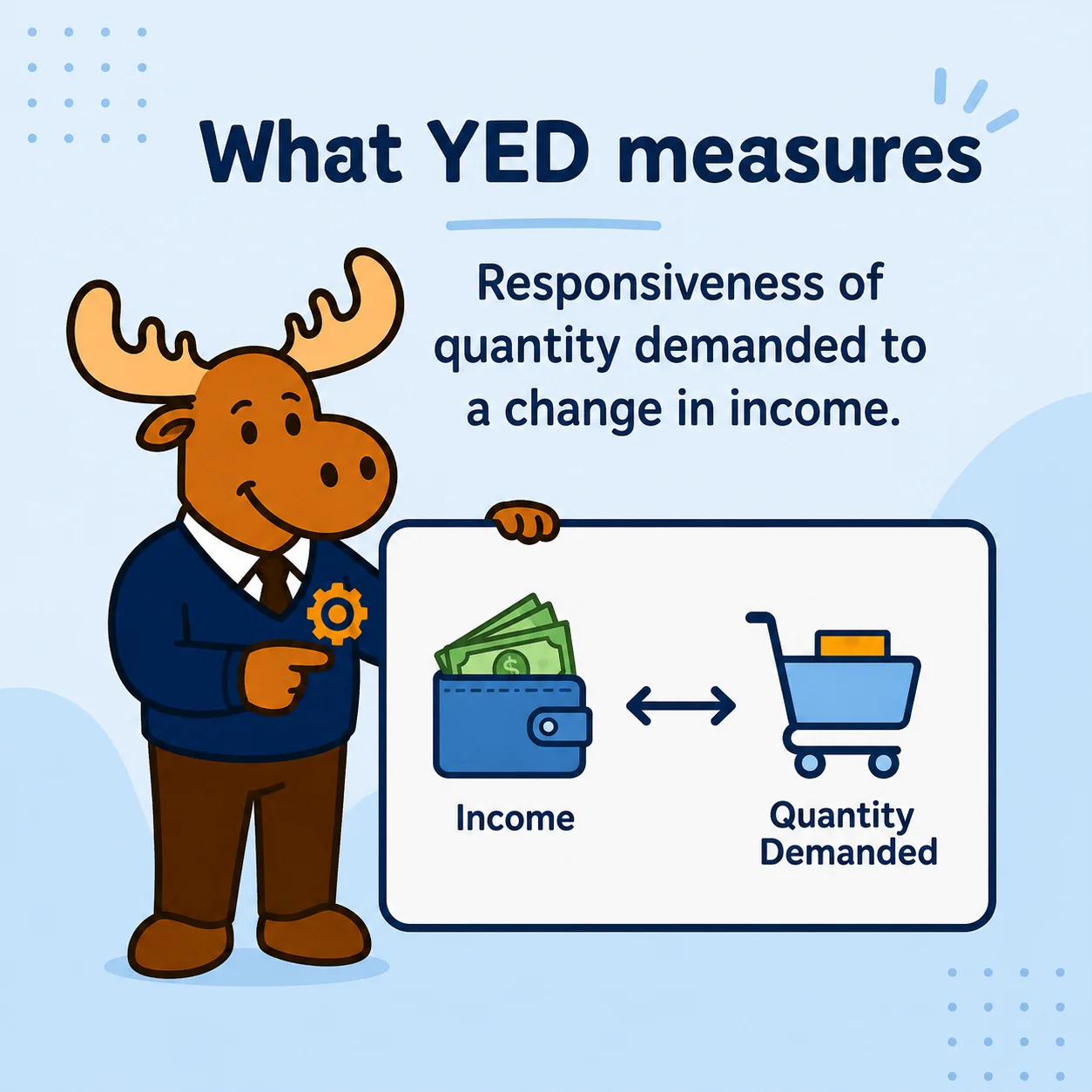
Income elasticity of demand, usually shortened to YED, measures how responsive demand is to a change in income. It helps economists understand how consumers change their spending when they become richer or poorer.
In IB Microeconomics, YED is important because income is one of the major non-price determinants of demand. When income changes, the demand curve can shift. This is different from price elasticity of demand, which measures movement along a demand curve after the price of the good itself changes.
YED helps explain why some industries grow quickly when incomes rise, while others may shrink. It also helps firms forecast demand, helps governments understand living standards, and helps students evaluate how economic growth or recession affects different markets.
The definition of income elasticity of demand
Income elasticity of demand measures the responsiveness of demand for a good or service to a change in consumer income, ceteris paribus.
The formula is:
YED = percentage change in quantity demanded divided by percentage change in income
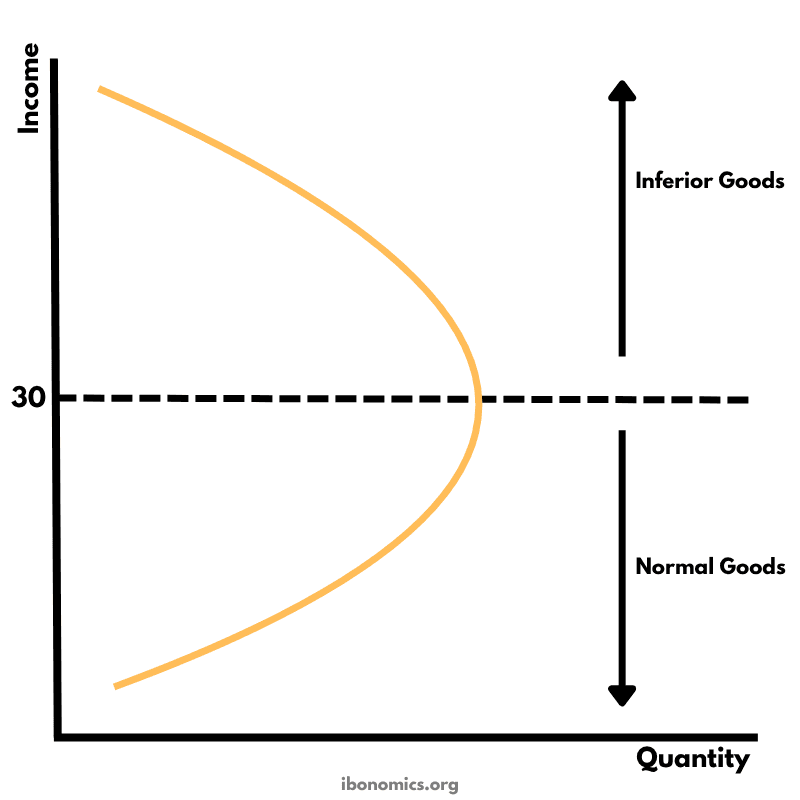
If income rises and demand for a good rises, YED is positive. This means the good is a normal good.
If income rises and demand for a good falls, YED is negative. This means the good is an inferior good.
The sign of YED tells us the type of good. The size, or magnitude, of YED tells us how responsive demand is to income changes.
This topic is explained in more detail in income elasticity of demand and the broader elasticities of demand unit.
What YED measures
YED measures the effect of income changes on demand. This means it explains a shift of the demand curve, not a movement along the demand curve.
In a demand diagram, price is on the vertical axis and quantity is on the horizontal axis. If the price of the good changes, quantity demanded changes along the existing demand curve. If income changes, demand itself changes, so the whole demand curve shifts.
For a normal good, an increase in income shifts demand to the right. Consumers are willing and able to buy more at each price. A fall in income shifts demand to the left.
For an inferior good, an increase in income shifts demand to the left. Consumers buy less of the good as they can afford preferred alternatives. A fall in income shifts demand to the right because consumers may switch back to cheaper options.
This connects closely to non-price determinants of demand, where income is one of the main causes of demand shifts.
Normal goods and inferior goods
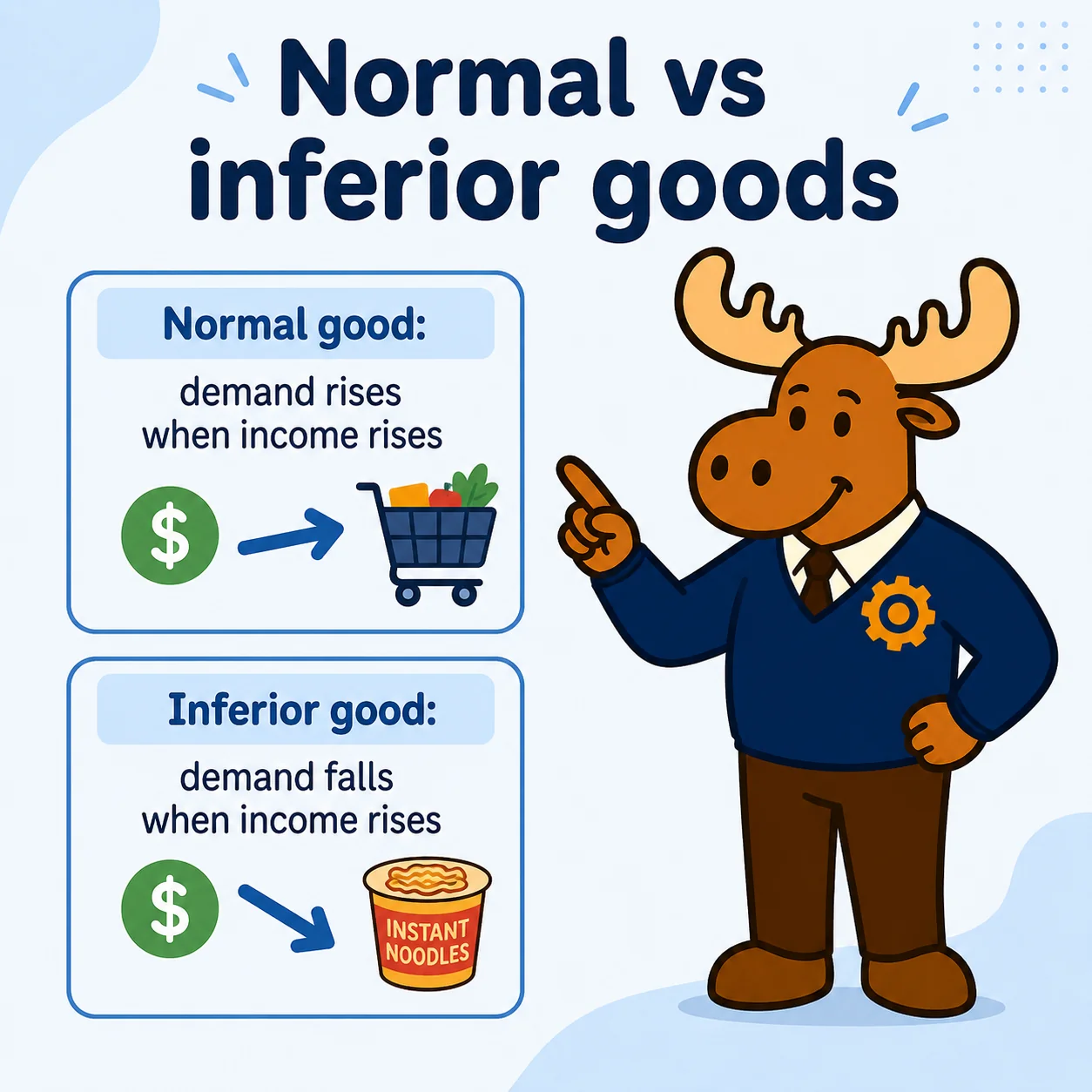
A normal good is a good for which demand increases when income rises, ceteris paribus. Normal goods have positive YED.
Most goods are normal goods. Examples may include restaurant meals, new clothes, private tutoring, streaming subscriptions and holidays. As consumers earn more income, they are often willing and able to buy more of these goods.
An inferior good is a good for which demand falls when income rises, ceteris paribus. Inferior goods have negative YED.
Inferior does not mean low quality in a moral or absolute sense. It means that consumers buy less of the good as their income increases because they switch to alternatives they prefer. Examples may include budget instant noodles, second-hand clothing for some consumers, or low-cost bus travel if higher-income consumers switch to cars, trains or taxis.
The classification depends on consumer preferences and context. A good may be inferior for one group of consumers but normal for another. This is why IB answers should avoid overgeneralising.
For example, public transport may be an inferior good in a city where higher-income consumers switch to private cars. But in another city with fast, comfortable and reliable public transport, it may remain a normal good for many consumers.
Luxuries and necessities
Among normal goods, YED can also distinguish between necessities and luxuries.
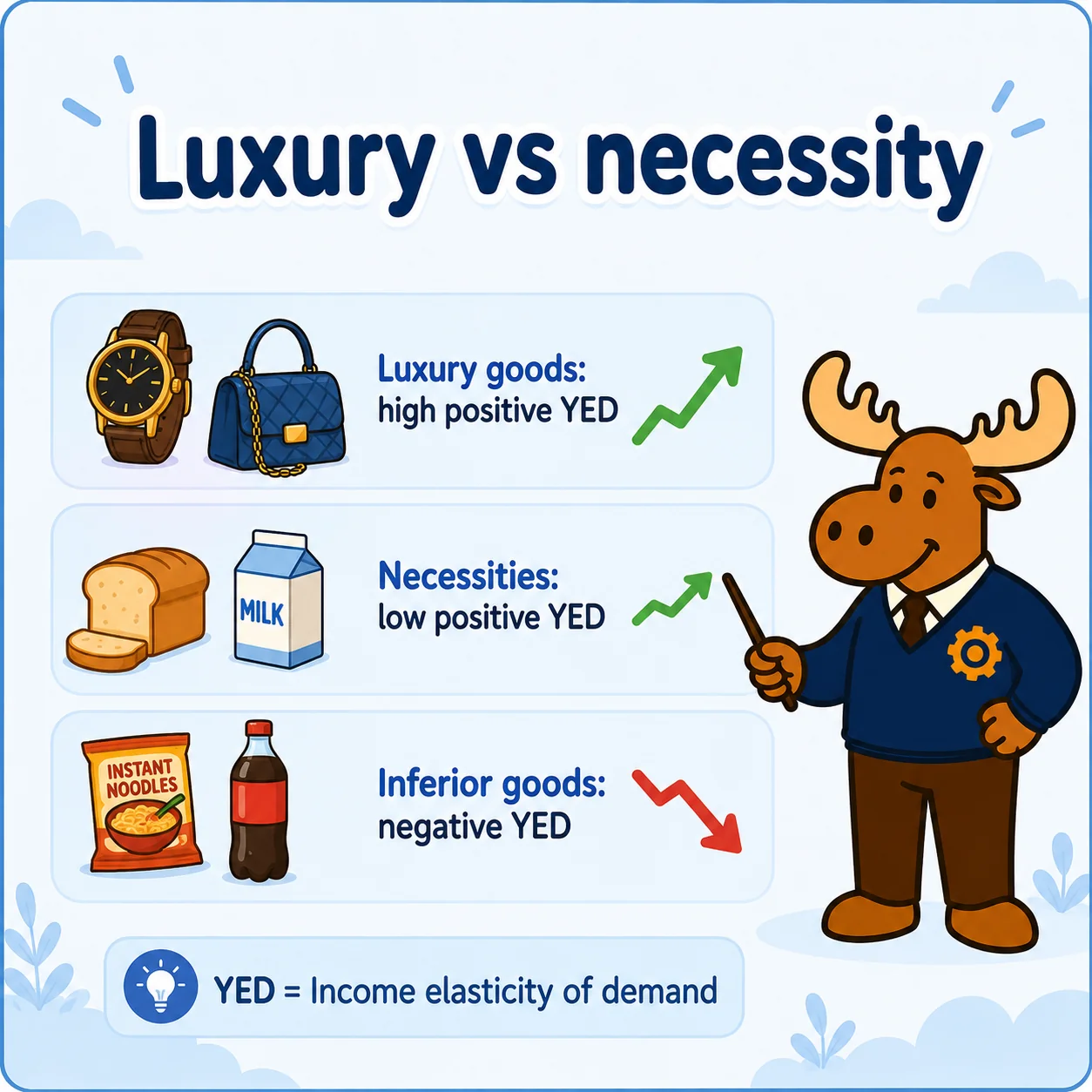
A necessity has positive but income-inelastic demand. This means YED is between 0 and 1. Demand rises when income rises, but proportionally less than income.
For example, if income rises by 10 percent and demand for basic groceries rises by 2 percent, the good is income inelastic. Consumers buy slightly more, but not much more, because they already need groceries even at lower income levels.
A luxury has positive and income-elastic demand. This means YED is greater than 1. Demand rises proportionally more than income.
For example, if income rises by 10 percent and demand for international holidays rises by 25 percent, the good is income elastic. Consumers respond strongly because luxury purchases are easier to increase when income rises and easier to reduce when income falls.
This distinction matters for firms. A business selling necessities may have relatively stable demand during recessions. A business selling luxuries may grow quickly during economic expansions but suffer more during downturns.
The sign and size of YED are covered further in the significance of YED sign and magnitude.
YED and demand curves
YED is linked to demand shifts. This is one of the most important diagram points for IB Economics students.
Suppose incomes rise in an economy. For a normal good, the demand curve shifts right from D1 to D2. Price is still on the vertical axis and quantity is still on the horizontal axis. The shift means consumers are willing and able to buy more at every possible price.
If supply stays fixed, the rightward shift of demand causes equilibrium price to rise and equilibrium quantity to rise. The size of the shift depends on how income elastic demand is.
For a luxury good with high positive YED, the demand curve may shift right significantly. For a necessity with low positive YED, the demand curve may shift right only slightly.
For an inferior good, the same income increase shifts demand left. If supply stays fixed, equilibrium price and quantity fall. This happens because consumers move away from the inferior good as their purchasing power increases.
The key distinction is that YED involves income changing demand, while a change in the good’s own price creates movement along the demand curve.
How to calculate and interpret YED
To calculate YED, divide the percentage change in quantity demanded by the percentage change in income.
For example, suppose average consumer income rises by 8 percent, and quantity demanded for a good rises by 16 percent.
YED = 16 percent divided by 8 percent = 2
Because YED is positive, the good is a normal good. Because YED is greater than 1, it is income elastic and can be classified as a luxury.
Now suppose income rises by 10 percent, and demand for another good falls by 5 percent.
YED = -5 percent divided by 10 percent = -0.5
Because YED is negative, the good is an inferior good.
In IB answers, do not stop at the calculation. Explain what the value means. A YED of 2 suggests demand responds strongly to income changes. A YED of 0.2 suggests demand responds weakly. A YED of -0.5 suggests demand moves in the opposite direction to income.
Why YED matters for firms
YED helps firms forecast demand when incomes change. This is especially useful for businesses planning production, pricing, marketing and investment.
Firms selling luxury goods may benefit strongly during economic growth because rising incomes can cause demand to increase proportionally more than income. Examples may include premium travel, designer clothing, expensive electronics or high-end restaurants.
However, these firms may also be more vulnerable during recessions. If incomes fall, demand for income-elastic luxury goods may fall sharply.
Firms selling necessities may experience more stable demand. Consumers still buy food, basic clothing, electricity and essential services even when income changes. This can make revenue more predictable, although firms may face strong competition and lower profit margins.
Firms selling inferior goods may see demand rise during recessions. For example, discount retailers or budget food producers may gain customers when household incomes fall. But when incomes recover, demand may fall as consumers switch to preferred alternatives.
For Higher Level students, this business relevance is developed in the importance of YED.
Why YED matters for governments
Governments can use YED to understand how economic growth or recession affects different sectors of the economy.
If an economy grows and incomes rise, demand for luxury goods and services may expand quickly. This can support employment and tax revenue in sectors such as tourism, leisure and consumer electronics. However, these sectors may also be more unstable during downturns.
YED can also help governments predict changes in demand for public services. For example, if private healthcare or private education are normal goods, demand for them may rise as incomes increase. If some public services are treated as inferior alternatives by higher-income households, demand patterns may change as incomes grow.
YED is also relevant to development. As countries become richer, the structure of demand often changes. Consumers may spend a smaller proportion of income on basic food and a larger proportion on services, education, healthcare, transport and leisure. This can influence employment patterns and long-term economic structure.
However, governments should be careful. YED values are estimates, and consumer behaviour depends on culture, preferences, inequality, expectations and access to alternatives.
IB exam relevance and common mistakes
YED is exam-relevant because it can appear in definitions, calculations, diagrams, data-response questions and evaluation.
A strong answer should define YED clearly, use the formula correctly, interpret both the sign and the magnitude, and apply the concept to a specific good or market.
A common mistake is confusing YED with PED. PED measures responsiveness to a change in the good’s own price. YED measures responsiveness to a change in income.
Another common mistake is saying that inferior goods are always cheap or bad quality. A good is inferior only if demand falls when income rises. The classification depends on consumer behaviour, not simply on the physical quality of the product.
Students also sometimes forget that YED causes demand to shift. If income changes, the whole demand curve shifts. It is not a movement along the curve unless the good’s own price changes.
Another mistake is ignoring the difference between luxuries and necessities. Both are normal goods because they have positive YED. The difference is magnitude. Necessities have YED between 0 and 1, while luxuries have YED greater than 1.
Finally, avoid assuming a good has the same YED for all consumers in all countries. The same good can be viewed differently depending on income level, culture, availability of substitutes and consumer preferences.
Evaluation: YED depends on context
YED is useful because it links income changes to demand shifts. It helps explain why some markets expand rapidly during growth and why others are more stable.
However, YED is not fixed. It can change over time as preferences, technology and living standards change. A product that was once a luxury may become a necessity. Smartphones, internet access and air travel are examples of goods or services that may be viewed differently across time and income groups.
YED can also vary between countries. A car may be a luxury in a low-income economy but closer to a necessity in a high-income economy with limited public transport. Similarly, restaurant meals may be a luxury for some households but a regular part of spending for others.
This is why IB evaluation should consider income level, time period, consumer group and the availability of alternatives. YED helps predict behaviour, but it does not remove the need for context.
Conclusion
Income elasticity of demand measures how responsive demand is to a change in income. A positive YED means the good is normal. A negative YED means the good is inferior. A YED between 0 and 1 indicates a necessity, while a YED greater than 1 indicates a luxury.
YED matters because income changes shift demand curves. It helps firms plan for growth or recession, helps governments understand changing demand patterns, and helps IB students explain how markets respond when consumers become richer or poorer.
The strongest IB answers interpret both the sign and magnitude of YED, distinguish demand shifts from movements along demand, and evaluate how income responsiveness depends on context.